
Every time you see H2O written on a water bottle or Fe printed on a supplement label, you are reading a language that scientists across the entire world share without translation. Chemical symbols are short, powerful, and deceptively deep. They are not just scientific shorthand. They carry centuries of history, cultural meaning, and even spiritual weight.
This complete guide breaks down what chemical symbols are, where they come from, what each major symbol means, and why humans across every culture are drawn to them. Whether you are a student, a curious reader, or someone who just spotted Au on a jewelry tag, this article has everything you need.
What Are Chemical Symbols?
A chemical symbol is a one or two letter abbreviation that represents a chemical element. Each symbol stands for a unique type of atom, the smallest unit of matter that retains its identity. These compact notations allow scientists, students, and researchers around the world to communicate complex chemical ideas quickly and clearly.
The modern system of chemical symbols was developed by Swedish chemist Jons Jakob Berzelius in 1813. Before his contribution, alchemists used confusing drawings and secret marks to represent matter. Berzelius introduced letters based on Latin or Greek names, making chemistry universally accessible. Later, Russian scientist Dmitri Mendeleev organized these symbols into the periodic table, revealing patterns that transformed scientific understanding forever.
Today, all 118 known chemical symbols are standardized by the International Union of Pure and Applied Chemistry (IUPAC), ensuring that the entire world speaks the same chemical language regardless of nationality or native tongue.
Deep Symbolic Meaning of Chemical Symbols
Chemical symbols are far more than scientific tools. They carry layers of meaning that touch on spirituality, psychology, and culture.
Spiritual Meaning
On a spiritual level, chemical symbols represent unity and origin. Every living thing on Earth, including the human body, contains oxygen, carbon, hydrogen, and calcium. These same elements exist inside stars, nebulae, and distant galaxies. This connection reveals a profound truth: you are made of the same matter as the universe itself. When a person sees the symbol O for oxygen or C for carbon, they are looking at the literal building blocks of all life. For many spiritual traditions, this fact reinforces the idea that separation is an illusion and that everything in existence is connected at an atomic level.
Alchemists historically treated elemental symbols as sacred keys to understanding the soul. They believed that mastering matter meant mastering the self. That ancient belief has not disappeared. It has simply evolved into a modern appreciation for how deeply science and spirituality overlap.
Psychological Meaning
Psychologically, chemical symbols represent clarity and control. The human brain is wired to love patterns. When a complex topic like atomic structure gets reduced to a single letter, the mind feels a sense of mastery over something once mysterious. Chemical symbols transform chaos into order and convert invisible forces into manageable ideas.
This is why students often describe a rush of confidence the moment they understand the periodic table. It feels like cracking a secret code. That feeling is real. Pattern recognition triggers reward pathways in the brain, and chemical symbols are one of science’s most elegant pattern systems.
Cultural Meaning
Culturally, chemical symbols represent humanity’s journey from ignorance toward understanding. They symbolize progress, discovery, and the collective intelligence of civilization. From the alchemists who kept elemental knowledge secret, to the open-source scientific community of today, chemical symbols have always marked the boundary between mystery and knowledge. They stand for medicine, technology, innovation, and the shared human desire to decode the natural world.
Types and Variations of Chemical Symbols
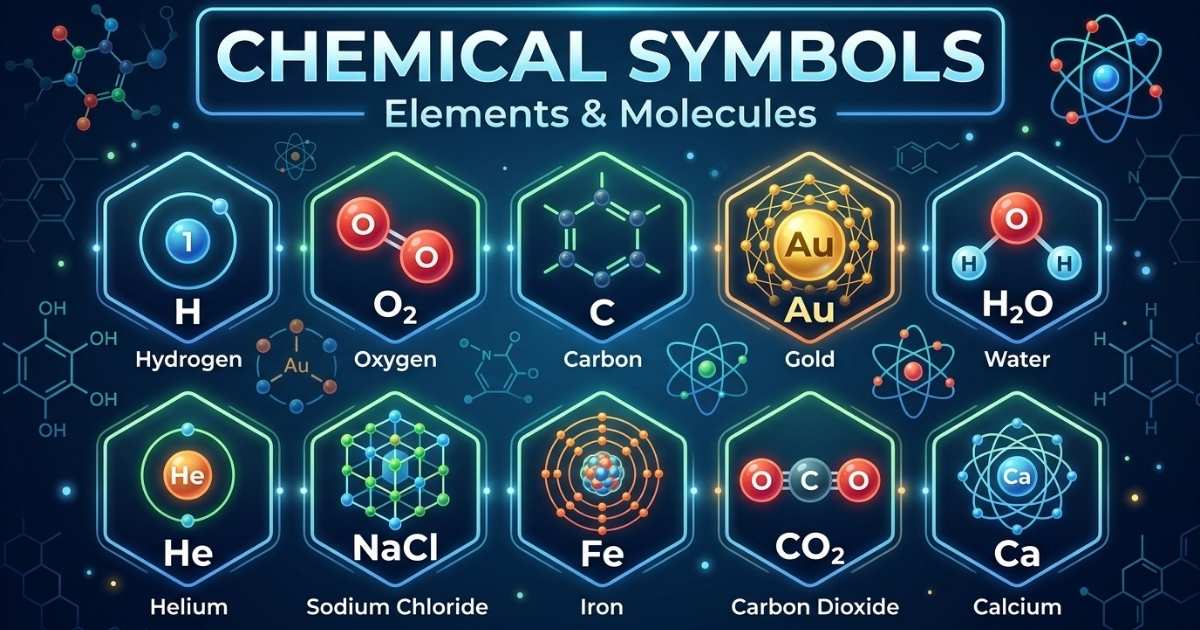
Each element carries its own symbol, origin story, and deeper meaning. Here are six of the most significant ones explained in full.
Hydrogen H
Hydrogen is the first element on the periodic table and the most abundant element in the universe. Its symbol H comes directly from its English name. Hydrogen makes up roughly 75 percent of all normal matter in existence by mass. It is the fuel of stars, a component of water, and the foundation of all organic chemistry.
Symbolically, hydrogen represents pure potential and new beginnings. Because it is the simplest atom, consisting of just one proton and one electron, it stands for everything that is fundamental, raw, and untouched. In discussions about clean energy and hydrogen fuel cells, H has taken on fresh meaning as a symbol of a sustainable future.
Oxygen O
The symbol O represents oxygen, the element that makes breathing possible. Discovered in the 18th century, oxygen accounts for about 21 percent of Earth’s atmosphere and is essential to almost all known life forms. Its name comes from the Greek words meaning “acid-forming.”
Beyond science, oxygen symbolizes life force, renewal, and healing. You find it in hospitals, emergency care, and discussions about environmental health. The O symbol has become a universal shorthand for survival itself.
Carbon C
Carbon’s symbol C reflects its Latin name Carboneum. It is the element that forms the backbone of all organic molecules, from the DNA in your cells to the graphite in a pencil to the diamond in a ring. Carbon’s ability to bond with itself and with countless other elements makes it the most versatile building block in chemistry.
Symbolically, carbon represents structure, identity, and physical existence. Without carbon, organic life as we understand it would be impossible. The C symbol quietly appears in every living organism on the planet.
Gold Au
Gold’s symbol Au comes from its Latin name Aurum. Gold was one of the first metals known to humanity and has been treasured for thousands of years across every major civilization. It does not rust, does not tarnish, and retains its brilliance across centuries.
The Au symbol carries meaning far beyond the lab. It represents wealth, immortality, and divine perfection. In alchemy, gold was the ultimate goal, the symbol of spiritual and physical completion. Today it appears on jewelry, in currency systems, in electronics, and in religious artifacts across every culture.
Iron Fe
Iron’s symbol Fe comes from the Latin word Ferrum. Iron is one of the most abundant elements on Earth and has been central to human civilization for thousands of years. The Iron Age gets its name from this element, and iron remains the backbone of modern construction and manufacturing.
Fe symbolizes strength, endurance, and protection. Iron also runs through human blood in the form of hemoglobin, making it essential not just for buildings and bridges, but for life itself. The Fe symbol bridges the gap between physical toughness and biological necessity.
Sodium Na
Sodium’s symbol Na comes from the Latin word Natrium. Sodium is a soft, highly reactive metal that most people encounter as part of table salt (NaCl). It plays a vital role in nerve function, muscle contraction, and fluid balance in the human body.
The Na symbol represents balance and essential function. Without sodium, the human nervous system cannot work. In excess, it becomes harmful. Na is a perfect reminder that even life-giving substances carry a dual nature.
Chemical Symbols Across Cultures
The story of chemical symbols is also a story of human civilizations trying to make sense of the material world.
Ancient Egypt
Egyptian alchemists believed that elements carried spiritual meaning. Gold represented immortality and divine power. Their elemental symbols were secret and sacred, known only to initiates. They believed that understanding matter meant understanding the soul, and their early chemical thinking blended science with religion in ways that still echo in modern spiritual traditions.
Ancient Greece
Greek philosophers believed that all matter was composed of four fundamental elements: earth, water, air, and fire. Thinkers like Aristotle and Hippocrates connected these elements to human health, temperament, and cosmic order. This philosophical tradition directly influenced scientists like Antoine Lavoisier, who later defined modern elements and reshaped chemistry as a discipline.
Islamic Golden Age
Muslim scientist Jabir ibn Hayyan, known in the West as Geber, developed early chemical classification systems and introduced systematic experimentation to the field. His work transformed alchemy from a mystical art into a proto-science. Chemical symbols shifted from sacred secrets to tools of rational inquiry during this period, laying the groundwork for modern chemistry.
Chinese Civilization
Ancient Chinese philosophy viewed the elements as dynamic forces of balance rather than fixed substances. The classical Chinese system of five phases (wood, fire, earth, metal, water) shaped how matter was understood in relation to health, nature, and the cosmos. Chinese civilization also contributed early metallurgical knowledge that influenced global understanding of iron, gold, and other key elements.
Modern Global Culture
Today, chemical symbols are the most universal written language on Earth. A scientist in Tokyo and a researcher in Lagos use the exact same symbols to describe the same reactions. IUPAC’s standardization ensures that no matter what language a chemist speaks, Fe is always iron and Au is always gold. In the 21st century, chemical symbols have become part of global culture, appearing in education systems, digital media, product labels, and popular entertainment worldwide.
Chemical Symbols in Art, Movies and Pop Culture
Science does not stay in laboratories. Chemical symbols have crossed into mainstream culture in a big way.
Movies and Television
The most famous example is the television series Breaking Bad. Its iconic logo highlighted the symbols Br (Bromine) and Ba (Barium) from the periodic table within the show’s title. The design, rendered in the style of a periodic table tile with green backgrounds, became one of the most recognized logos in television history. The choice of symbols was intentional. Bromine is used in fire retardants while barium appears in fireworks, two elements with opposing effects, mirroring the contradictions at the heart of the show’s main character. The visual style the show popularized became a genre of its own, inspiring periodic table themed designs across classrooms, merchandise, and social media.
Tattoos
Chemical symbols and molecular structures have become a major category in tattoo culture. The molecules for serotonin, dopamine, and oxytocin rank among the most popular choices, letting people wear the chemistry of happiness and connection on their skin. Element symbols like Au, Fe, and H2O appear as minimalist tattoos representing personal meaning, identity, and values. DNA strands, atomic structures, and periodic table tiles are all popular formats, each carrying individual significance for the wearer.
Fashion
Periodic table aesthetics have moved from textbooks to clothing, accessories, and jewelry. Element symbol necklaces have become especially popular among science enthusiasts and professionals. Wearing Au on a necklace is both a scientific statement and a fashion choice. Printed periodic table patterns appear on everything from T-shirts to phone cases, turning chemistry into a design language that signals intelligence and curiosity.
Art and Design
Contemporary artists use chemical symbols to explore themes of identity, existence, and the nature of matter. Element symbols like C and O become abstract statements in visual art. Designers combine periodic table aesthetics with typography to create work that bridges scientific literacy and artistic expression. The geometry and symmetry of chemical notation also lend themselves naturally to graphic design and architectural art.
Spiritual and Dream Meaning of Chemical Symbols
When chemical symbols appear in dreams or meditative states, many traditions interpret them as meaningful signals from the subconscious.
Dream Meaning of Oxygen Symbol O
Dreaming of the oxygen symbol O often reflects emotional renewal and a desire for clarity. Oxygen keeps us alive, and its appearance in dreams can signal that you are entering a phase of healing, fresh perspective, or new emotional growth. It may indicate that your mind is seeking space to breathe, literally or figuratively.
Dream Meaning of Gold Symbol Au
When the gold symbol Au appears in a dream, it often points to self-worth and inner value. Gold represents perfection and endurance, so dreaming of Au may mean you are beginning to recognize your own potential or approaching a significant personal achievement.
Dream Meaning of Iron Symbol Fe
Iron in dreams tends to represent strength, resilience, and the ability to endure hardship. Seeing the Fe symbol can suggest that your subconscious is preparing you for a challenge that requires mental toughness. It may also reflect a need to protect yourself or to stand firm under pressure.
Spiritual Meaning Overall
Across spiritual traditions, chemical symbols serve as reminders that all physical reality is interconnected at its most fundamental level. They point to the idea that the universe is not random but structured, coded, and deeply ordered. Many people find comfort in the fact that the iron in their blood is the same iron forged in ancient stars. For those drawn to spiritual thinking, this is not just poetic. It is a physical fact that carries profound metaphysical weight.
Positive vs Negative Meaning of Chemical Symbols
Like all powerful symbols, chemical elements carry both light and shadow.
Positive Meaning
Chemical symbols represent humanity’s greatest achievements. They symbolize life-saving medicine, clean energy technology, and scientific advancement. The H symbol stands for hydrogen power and a cleaner future. The C symbol appears in carbon-based medicine and organic chemistry. Au represents beauty, endurance, and cultural heritage across civilizations. Chemical symbols remind us that knowledge, when used wisely, creates a better world.
Negative Meaning
The same symbols that represent life can also represent destruction. Carbon emissions are driving climate change. Iron weapons have fueled wars throughout human history. Chemical symbols appear in descriptions of toxic compounds, environmental pollutants, and nuclear materials. They remind us that knowledge itself is neutral, and that human choices determine whether elements become tools of creation or instruments of harm.
Why Humans Are Attracted to Chemical Symbols
The global appeal of chemical symbols is not accidental. Several deep human drives explain why these simple notations resonate so powerfully.
They Reveal Hidden Truth
Chemical symbols pull back the curtain on reality. They show that the visible world is built from invisible building blocks with precise, discoverable identities. That revelation never loses its appeal.
They Simplify Complexity
One of the most satisfying human experiences is finding simplicity inside complexity. Chemical symbols do exactly that. A single letter represents an entire category of matter. That compression feels elegant and powerful.
They Connect Us to the Universe
The elements in chemical symbols are literally the same matter that forms stars, planets, and galaxies. Recognizing that connection touches something profound in human consciousness. We are not separate from the cosmos. We are made of it.
They Represent Intelligence
Chemical symbols are associated with scientific literacy, education, and intellectual achievement. Wearing or displaying them signals curiosity, a value that many people hold deeply.
They Are Universal
No other written system crosses as many cultural, linguistic, and national boundaries as chemical symbols. Au means gold whether you are reading it in Arabic, Mandarin, Spanish, or English. That universality gives them a rare kind of authority and resonance.
FAQ’s
What is a chemical symbol?
A chemical symbol is a one or two letter abbreviation that represents a specific chemical element on the periodic table, standardized globally by IUPAC.
Why does gold have the symbol Au instead of G?
Au comes from the Latin word Aurum, meaning gold. Many elements discovered in ancient times carry symbols based on their Latin or Greek names rather than modern English ones.
Why does iron use the symbol Fe?
Fe comes from the Latin word Ferrum, which was the classical name for iron used throughout ancient Rome and medieval science.
Why does sodium use Na as its symbol?
Na comes from Natrium, the Latin name for sodium, which was the term used in early European chemistry before modern English naming conventions developed.
Who standardizes chemical symbols today?
The International Union of Pure and Applied Chemistry (IUPAC) is the global authority that officially names and standardizes all chemical element symbols.
How many chemical elements have symbols?
There are currently 118 confirmed elements, each with its own unique symbol recognized worldwide.
Can chemical symbols appear in spiritual or dream contexts?
Many spiritual traditions and dream interpretation frameworks view chemical symbols as reflections of transformation, awareness, and connection to the natural world.
Conclusion
Chemical symbols are one of humanity’s most elegant inventions. In one or two letters, they capture an element’s identity, history, and meaning. From the hydrogen powering the sun to the iron running through your blood, these symbols quietly define everything that exists.
Understanding chemical symbols is not just a science exercise. It is a way of reading the universe’s own language. Whether you encounter them in a laboratory, on a piece of jewelry, in a tattoo parlor, or in a dream, each symbol carries a story that stretches back billions of years. Once you learn to read them, you start to see that the world is not random matter but a beautifully coded system, and you already know the alphabet.

Christopher Davis is the pun-loving voice behind Giggles Magazines, serving quick laughs and clever wordplay with every post. He believes a good pun can brighten any day, and he’s here to prove it. 😄