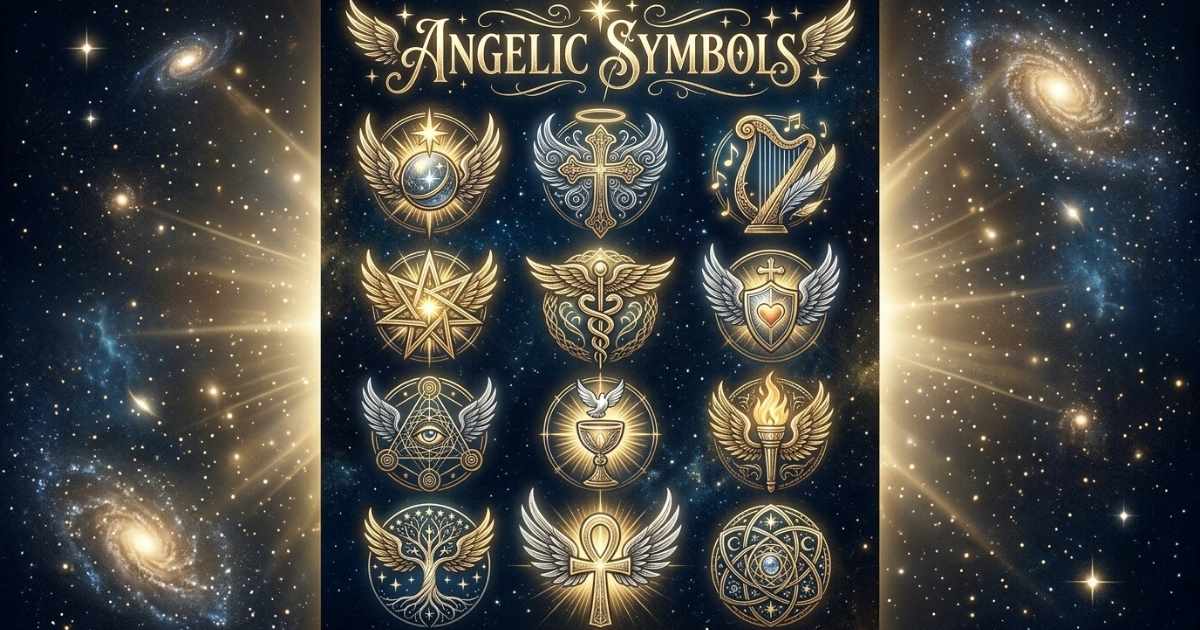

Have you ever looked at a symbol and felt something shift inside you? Long before written language, humans carved, painted, and wore symbols to connect with forces beyond themselves. Angelic symbols are among the oldest and most powerful of these sacred marks. They appear on ancient temple walls, in medieval manuscripts, on modern tattoos, and even in Hollywood blockbusters. From the winged figures of ancient Mesopotamia to the intricate sigils found in 17th-century grimoires, these symbols have shaped how entire civilizations understood the divine, protection, and the invisible forces guiding human life.
This guide takes you through every dimension of angelic symbols, including their origins, individual meanings, cultural significance, spiritual depth, and practical uses in everyday life today.
What Are Angelic Symbols?
Angelic symbols are sacred signs, marks, or visual representations believed to embody the energy, presence, or messages of angels and other celestial beings. They function as bridges between the physical and spiritual worlds, used in prayer, meditation, healing, protection rituals, and artistic expression.
The word “angel” traces back to the Hebrew word mal’akh, meaning messenger or minister. In Greek it became anghelos, from which our English word “angel” is derived. Angels themselves are defined in theology as purely spiritual beings created by God, superior to humans, serving as intermediaries between heaven and earth. Their symbols naturally inherit this intermediary role: they are tools meant to translate divine presence into a form the human mind can receive and understand.
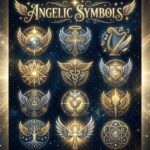
Throughout history, angelic symbols have taken many forms. Some are geometric, such as circles and stars. Others are figurative, such as wings and halos. Still others are script-based, drawn from mystical alphabets like Enochian or Kabbalistic systems. Together they form one of the richest visual vocabularies in human spiritual history.
Angelic Symbols And Their Meanings
Symbols For Angels
The most recognizable symbols for angels include wings, halos, trumpets, light, feathers, and doves. Each carries a layered meaning rooted in theology and cultural tradition.
Wings represent the ability of angels to move between heavenly and earthly realms, symbolizing speed, divine authority, and freedom from physical limitation. The halo, a ring of light placed above the head, communicates holiness and spiritual purity, visually separating divine beings from ordinary humans in religious art. The trumpet signals awakening, divine announcement, and the delivery of sacred messages, particularly in biblical imagery. Feathers, especially white ones, are widely seen as signs of an angel’s nearby presence. Doves communicate peace, purity, and the arrival of divine goodwill.
Circles are also commonly associated with angels, representing eternity, wholeness, and the unending cycle of divine energy. Stars appear in many angelic traditions as signs of guidance, enlightenment, and cosmic connection.
Angelic Symbols Copy And Paste
Many people look for angelic symbols they can copy and paste in digital spaces for social media bios, tattoo reference boards, spiritual journals, or decorative purposes. Some commonly used Unicode characters associated with angels include the halo emoji (🔱), wing glyphs, and star symbols. While these digital shorthand versions carry none of the sacred weight of traditional sigils, they reflect how modern culture keeps angelic imagery alive in everyday communication.
Read More: 88+ Powerful Life Symbols and Their Deep Meanings That Will Change Your Perspective
Angelic Symbols Emoji
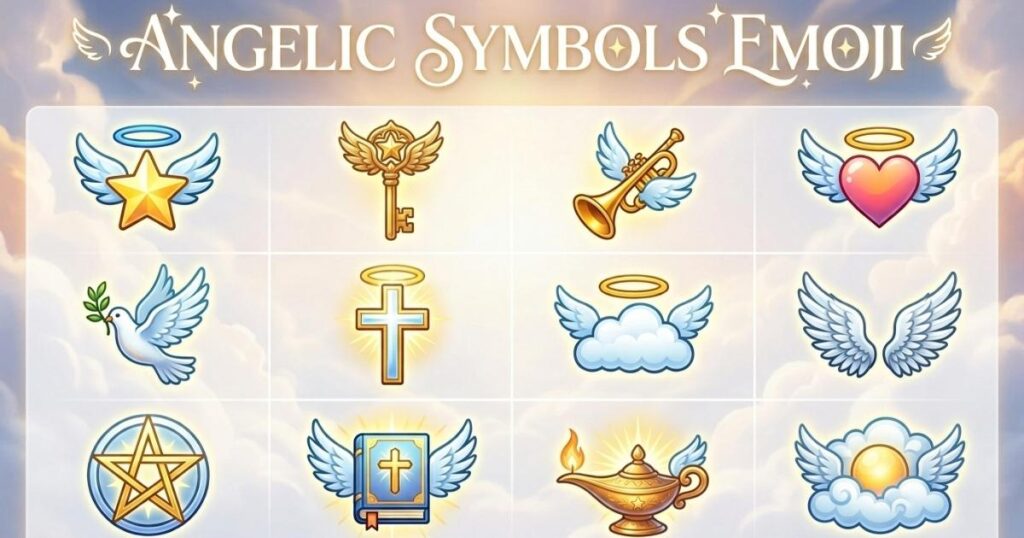
The angel emoji (👼) typically depicts a cherubic face with a halo, representing innocence, kindness, and divine goodness. The dove emoji (😺) is used to symbolize peace and angelic presence. These digital symbols are casual cultural stand-ins, drawing on centuries of iconographic tradition without the ceremonial context.
Angelic Symbols Crossword Clue
In crossword puzzles, common clues for angelic symbols include answers like HALO, WING, or NIMBUS. The halo is the most frequently cited answer, as it is the most visually iconic attribute separating angels from human figures in Western religious art.
Angelic Symbols And Meanings
Each category of angelic symbol carries its own distinct set of meanings. Wings represent divine mobility and protection. The halo communicates enlightenment and moral goodness. The sword, particularly in imagery of Archangel Michael, means spiritual strength and the cutting away of negativity. The chalice, associated with Archangel Gabriel, speaks to receptivity and nurturing wisdom. Light, in virtually every tradition, is one of the most powerful signs of angelic presence, representing truth, clarity, and divine grace.
Angel Symbol Text
Angel symbol text refers to written or typographic representations of angelic energy, including Enochian script (the “angelic alphabet” developed by occultist John Dee in the 16th century), Kabbalistic letter systems, and ancient sigils drawn from ceremonial magic texts like The Grimoire of Armadel, a 17th-century volume illustrating intricate sigils used to invoke the power of archangels.
Types Of Angelic Symbols And Uses
Angelic Symbols List
A foundational angelic symbols list includes the following:
Wings: divine protection and transcendence. Halo: holiness and spiritual illumination. Sword: courage, truth, and spiritual warfare. Trumpet: divine announcements and awakening. Dove: peace and angelic communication. Chalice: receptivity and nurturing energy. Feathers: signs of angelic nearness. Circles: eternity and divine wholeness. Stars: cosmic guidance and enlightenment. Keys: unlocking hidden spiritual truths. Sigils: personalized symbols for invoking specific archangels.
Angelic Symbols Of Protection
Angelic symbols of protection are among the most sought-after in spiritual practice. The Archangel Michael’s sword is the most iconic, representing the cutting of negative energetic cords and the shielding of the faithful from harm. The Cho Ku Rei symbol, used in Angelic Reiki, can be drawn on chakras or spaces to create a protective energetic layer. Circular symbols are often used as protective seals in ceremonial traditions. In folk spirituality, feathers found unexpectedly are treated as signs that angelic protection is already present.
Read More: Chemical Symbols Explained | Complete Guide to Elements and Their Meanings for 2026
Angelic Symbols Tattoo
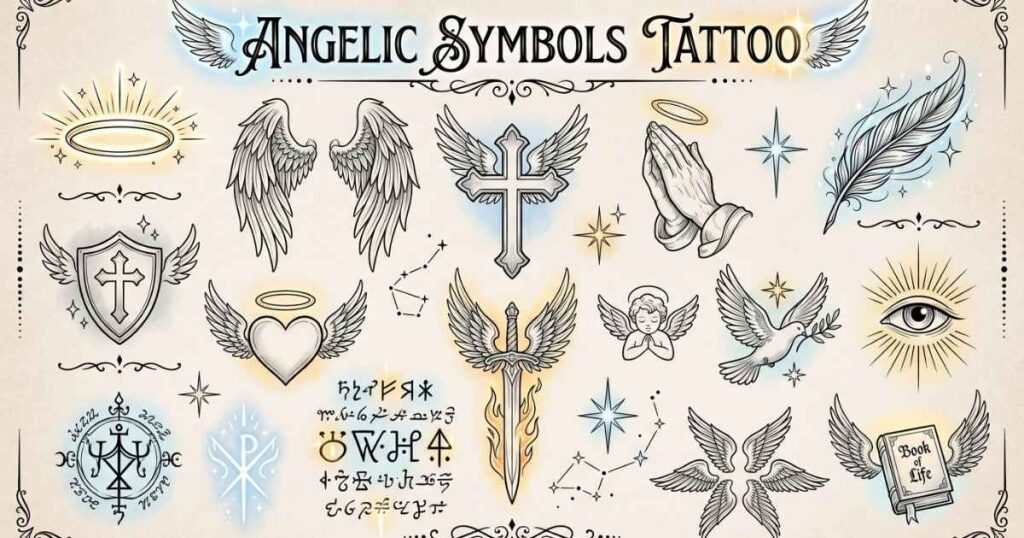
Angelic symbol tattoos have surged in popularity as a way of wearing spiritual meaning on the body. Common choices include angel wings (representing freedom and divine guidance), halos (spiritual purity), feathers (angelic presence), and archangel sigils (for invoking specific protective energies). Perhaps the most culturally famous example of angelic symbol tattoos is Nightcrawler from Marvel’s X-Men franchise, discussed in greater detail in the pop culture section below.
Angelic Symbols Pdf
Angelic symbols PDFs are popular downloads in spiritual communities, offering illustrated reference guides to angelic sigils, archangel symbols, Zibu symbols, and protection seals. These reference documents are commonly used by Reiki practitioners, tattoo artists, spiritual artists, and students of angelology.
Angel Signs And Symbols
Angel signs are naturally occurring phenomena that people interpret as messages from angelic beings. These include finding white feathers in unexpected places, seeing repeating number sequences (111, 222, 444), noticing rainbows after prayer, or feeling a warm, unexplained presence during moments of emotional need. Angel signs differ from angel symbols in that signs are perceived in the environment, while symbols are consciously created visual marks.
Angel Symbolism
Angel symbolism as a broader concept encompasses the entire range of meaning humans project onto celestial beings: hope, guidance, protection, moral goodness, divine love, and the possibility of something beyond physical existence. Angels symbolize the idea that humans are not alone, that unseen forces of goodness are at work in the world, and that death is not an ending but a transition guided by loving spiritual presences.
Advanced And Ancient Angelic Symbol Meanings
Angelic Symbols For Protection
Beyond the general protective symbols already noted, advanced practitioners work with specific archangel sigils drawn from grimoire traditions. Archangel Michael’s sigil is most commonly used for protection. It is typically visualized as a sword with a blue flame, representing the power to cut through spiritual opposition and shield against negative forces. These sigils are traced in the air, drawn on paper, or carved into objects used as talismans.
Angelic Reiki Symbols And Meanings
Angelic Reiki is a healing modality that bridges traditional Usui Reiki and angelic energy work. The main Angelic Reiki symbol features a central diamond shape surrounded by four smaller diamonds, each representing an element (earth, air, fire, and water), and also incorporates the numbers 3, 6, and 9, representing the Trinity, balance, and completion in numerology. The system links specific archangels to traditional Reiki symbols: Cho Ku Rei is associated with Archangel Gabriel (the power of divine love), and Sei He Ki is connected to Archangel Raphael (healing, joy, and grace). These symbols are used to activate healing energy, clear negative patterns, and create sacred space during sessions.
Ancient Angel Symbols
Ancient angel symbols predate organized religion. In Mesopotamia, winged beings called Lamassu, depicted as bulls or lions with human heads, were carved at city entrances as divine guardians. Their wings communicated protection and transcendence. In ancient Egypt, winged figures guided souls through the underworld and into the afterlife. These early images established the visual language that would later define how angels look in Jewish, Christian, and Islamic traditions.
Ancient Angelic Symbols
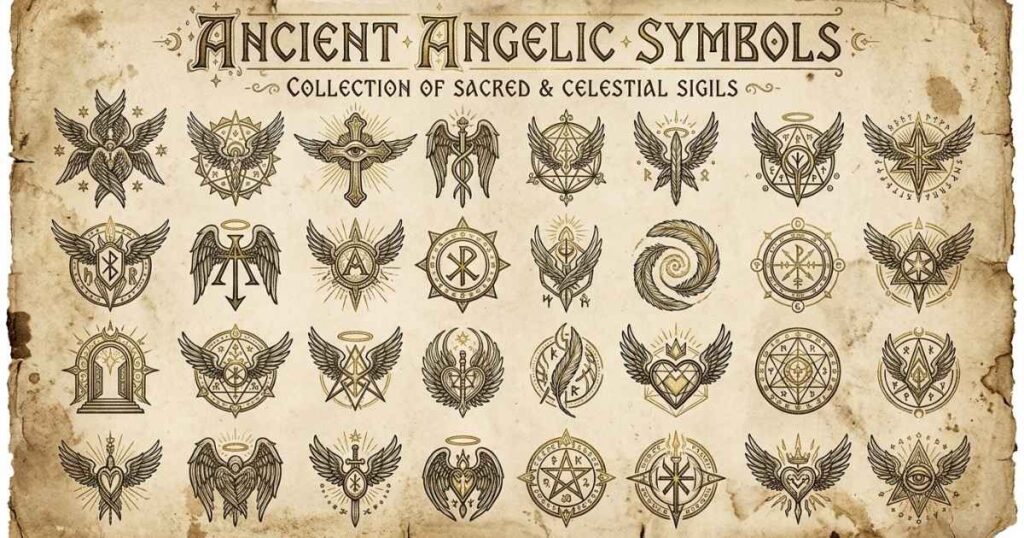
Ancient angelic symbols include the Enochian alphabet, attributed in occult tradition to a language of angels. This system was recorded by the Elizabethan occultist John Dee and his associate Edward Kelley in the 16th century. The symbols from The Grimoire of Armadel (17th century) represent another ancient layer, with intricate sigils for each archangel. In Norse tradition, the Valkyries served as divine messengers guiding fallen warriors, and their associated symbols shared the same energetic territory as angelic imagery in other cultures.
Zibu Angelic Symbols And Meanings
Zibu angelic symbols are a specific system of 88 spiritual symbols introduced by Debbie Z. Almstedt in 2004 following what she described as a personal spiritual experience. Each symbol represents a high-vibrational concept such as gratitude, peace, love, abundance, or divine connection. The symbols are designed to help practitioners attune to specific energetic frequencies. They are used by drawing them on paper, skin, or tracing them in the air, with the intention that the act of drawing activates the associated energy. Practitioners are encouraged to develop a personal routine with the symbols, as consistent use is said to deepen their effect.
Angelic Symbols Gabriel
Archangel Gabriel’s symbols are among the most detailed and meaningful in the angelic tradition. His primary symbols include a silver chalice with a white dove above it (representing receptivity, nurturing, and the purity of divine messages), a white lily (representing the purity required to receive divine communication), and a trumpet (representing the power of the divine word made audible). Gabriel is also associated with lunar energy, the color white or soft gold, and crystals such as clear quartz and selenite. His sigil is used to invite clarity, creative inspiration, and honest communication.
Nightcrawler Angelic Symbols
One of the most culturally famous uses of angelic symbols in fiction comes from Nightcrawler in Marvel’s X-Men franchise. In the film X2: X-Men United (2003), the character Kurt Wagner (Nightcrawler) covers his blue skin with intricate markings he describes as “angelic symbols, passed on to mankind by the archangel Gabriel, one for every sin.” The markings are based on Enochian script combined with alchemical symbols, designed by body artist Daemon Rowanchilde. The scarification-style etching was conceived as a form of penance, with each symbol representing a sin the deeply Catholic character believed he had committed. The design was so compelling that the film’s writers incorporated the symbols into Nightcrawler’s backstory, making them a key element of his character.
Zibu Angelic Symbols
As a standalone system, Zibu symbols are gateways to what their creator describes as divine energy existing within and around all living beings. Unlike traditional angelic sigils, Zibu symbols are not tied to specific archangels but instead represent universal spiritual values. Their flowing, calligraphic style gives them aesthetic appeal that has made them popular in tattoo art and decorative spirituality.
D&D Angelic Symbols
In Dungeons and Dragons (D&D), angelic symbols appear in alignment imagery, celestial creature lore, and divine spell iconography. Celestial beings in D&D carry visual hallmarks drawn from real-world angelic traditions: halos, wings, radiant light, and swords. Protective symbols and divine seals feature prominently in class abilities tied to clerics and paladins, making angelic iconography a functional gameplay element as well as a worldbuilding aesthetic.
Angelic Symbols Meaning
At their core, all angelic symbols share one fundamental meaning: connection. They are visual anchors for the human desire to reach beyond the physical world and touch something greater, wiser, and more loving. Whether used in prayer, healing, art, or tattooing, these symbols carry the accumulated intention of every person who has ever looked at them and felt, for a moment, less alone.
Ancient Angelic Symbols And Meanings
Ancient angelic symbols and their meanings form a constellation of ideas that have remained surprisingly consistent across millennia and cultures. Wings mean transcendence and protection. Light means truth and divine presence. The sword means righteous power. The chalice means spiritual receptivity. What changes across time and tradition is the specific figure holding these attributes, not the attributes themselves, a testament to the universality of the human spiritual experience.
Deep Symbolic Meaning of Angelic Symbols
Spiritual Meaning
Spiritually, angelic symbols serve as antennas, tuning human consciousness toward divine frequencies. In every major tradition, these symbols are not considered mere decoration but active spiritual tools. When a believer wears an angel wing pendant, traces a Reiki sigil, or meditates on a Zibu symbol, the act itself is understood as an invitation to divine energy. The symbols help humans hold faith in visible form during times when invisible support feels distant.
Psychological Meaning
Psychologically, angelic symbols tap into universal archetypes identified by Carl Jung as the collective unconscious. The winged figure, the radiant light, the protective sword: these images appear across cultures with no direct contact, suggesting they reflect something deep in human psychological wiring. Angels and their symbols represent the ideal: the being that is powerful yet protective, divine yet personal, transcendent yet present. For individuals facing grief, fear, or uncertainty, angelic symbols provide an external focal point for internal hope.
Cultural Meaning
Culturally, angelic symbols are markers of shared belief and identity. In Christian communities, wearing a cross or a halo icon identifies one as part of a tradition. In New Age spiritual communities, Zibu or Reiki symbols signal a shared practice. Even in secular contexts, angel imagery on greeting cards, jewelry, and home decor communicates universal values of care, protection, and love, divorced from specific religious doctrine but carrying its emotional weight.
Types and Variations of Angelic Symbols
Angel Wings
Angel wings are the most universally recognized angelic symbol, appearing in art, jewelry, tattoos, home decor, and fashion across cultures. They communicate freedom, divine protection, transcendence, and the presence of heavenly beings. In Renaissance art, wings were painted with ornithological precision to suggest literal flight. In modern design, they are often stylized into elegant minimal lines.
Halo
The halo is a circular ring of light, placed above the head to indicate holiness and divine illumination. Versions of this image appear in ancient Greek, Roman, and Buddhist art before its adoption into Christian iconography. In angel symbolism, the halo emphasizes that angels operate from a place of clarity, moral purity, and higher consciousness.
Trumpet
The trumpet is Gabriel’s signature symbol across nearly all traditions. It represents the power of divine sound to create reality, the voice of God made audible, and the announcement of sacred events. In biblical prophecy, trumpets herald the most significant cosmic transitions, reinforcing their association with divine communication and awakening.
Eye of God
The Eye of God (or All-Seeing Eye) appears frequently in angelic iconography as a symbol of divine omniscience and watchful protection. It is associated with seraphim, the highest order of angels, who in biblical description are covered with eyes representing the all-seeing awareness of the divine.
Angel Numbers
Angel numbers are repeating numerical sequences (111, 222, 333, 444, 777) that many people believe carry messages from angelic beings. Each sequence carries a specific meaning: 111 is associated with new beginnings and alignment, 444 with protection and grounding, 777 with spiritual awakening and divine guidance. Though angel numbers are not symbols in the traditional visual sense, they function as signs within the broader ecosystem of angelic symbolism.
Angelic Symbols Across Cultures
Angelic symbols do not belong to one tradition. They are a global human phenomenon.
In ancient Judaism, angels were divine messengers and protectors, with Michael representing strength and Gabriel representing divine communication. In Christianity, angels announced sacred events and served as guardians, with the full visual vocabulary of wings, halos, and light developed over centuries of religious art. In Islam, angels called Malaikah are described as beings of light, with Jibril (Gabriel) delivering divine revelation and other angels recording human deeds. In Zoroastrianism, winged guardian spirits called Fravashis accompany each person through life, making Zoroastrianism one of the earliest traditions to codify the idea of a personal guardian angel. In Hinduism, celestial beings called Devas and apsaras function similarly to angels, serving as intermediaries between human and divine realms. In Norse mythology, the Valkyries guided fallen warriors between realms, occupying the same symbolic territory as angels in monotheistic traditions.
Angelic Symbols in Art, Movies and Pop Culture
Angelic imagery has shaped some of the most celebrated works of human creativity. Raphael’s Sistine Madonna features two small cherubs at the bottom of the composition that have become among the most reproduced angelic images in history. Leonardo da Vinci’s Annunciation depicts Gabriel with wings of exquisite naturalism, communicating divine purpose through precise artistic observation. William Blake’s poetry and illustrations used angelic figures as symbols of spiritual insight and the creative imagination. John Milton’s Paradise Lost presented angels as complex, autonomous beings, transforming them from simple messengers into fully realized characters with moral stakes.
In cinema, angelic symbolism is woven into countless films. In the X-Men franchise, Nightcrawler’s angelic symbol tattoos became a memorable character detail blending faith, penance, and identity. In Angels in America, celestial imagery carries the full weight of mortality, politics, and spiritual crisis. Video games, particularly fantasy role-playing games, routinely use angelic iconography to represent the highest tier of divine power and moral alignment.
Spiritual and Dream Meaning of Angelic Symbols
Encountering angelic symbols in dreams is widely interpreted as a message from the unconscious or the divine, depending on the believer’s framework. Dreaming of wings often signals a desire for freedom or an upcoming transition. A glowing halo in a dream may indicate clarity arriving after confusion. A trumpet can represent a wake-up call, either spiritual or practical. Feathers appearing in dreams are commonly interpreted as reassurance that one is protected and not alone. Across most spiritual traditions, angelic dream imagery is considered positive and reassuring, an invitation to trust the journey and remain open to guidance.
Positive vs Negative Meaning of Angelic Symbols
Most angelic symbols carry profoundly positive meanings. Wings represent liberation. Halos represent goodness. Feathers represent comfort. However, like all powerful symbols, they exist within a broader context that includes shadow.
The fallen angel is itself an angelic symbol, representing the consequences of pride, rebellion, and the misuse of divine gifts. The image of the dark angel or fallen seraph has inspired vast artistic and literary traditions exploring the price of turning away from divine order. In this sense, even negative angelic symbolism carries a moral teaching, not a curse. The sword can protect or harm depending on whose hand holds it. The light that illuminates can also reveal what we would prefer to keep hidden. Understanding both dimensions makes the symbols richer and more honest.
Why Humans Are Attracted to Angelic Symbols
Human attraction to angelic symbols reflects something fundamental about consciousness. People are drawn to the idea that they are seen, protected, and guided by forces that transcend their own limitations. In psychological terms, angelic symbols provide external anchors for internal states of hope, trust, and courage. In spiritual terms, they represent authentic contact with a larger order of being.
Angelic symbols also endure because they are beautiful. The graceful curve of a wing, the perfect circle of a halo, the elegant flow of a Zibu symbol: these forms satisfy an aesthetic instinct as much as a spiritual one. They remind humans that the sacred and the beautiful are not opposites but expressions of the same underlying reality.
FAQ’s
What are the most common angelic symbols?
The most common angelic symbols include wings, halos, feathers, doves, trumpets, and archangel sigils.
What do angelic symbols mean in spiritual practice?
In spiritual practice, angelic symbols serve as tools for connecting with divine energy, inviting protection, healing, and guidance.
What are Zibu angelic symbols?
Zibu symbols are a set of 88 spiritual symbols introduced in 2004, each representing a high-vibrational energy such as peace, gratitude, or abundance.
What are Nightcrawler’s angelic symbols?
Nightcrawler’s markings in X-Men are Enochian and alchemical symbols representing one sin each, depicted as a form of Catholic penance.
Are angelic symbols the same across all religions?
No, each tradition has its own angelic iconography, though themes of protection, divine communication, and light appear consistently across cultures.
What is the angelic symbol for Gabriel?
Gabriel’s primary symbols are the trumpet (divine announcement), a silver chalice with a white dove (receptivity), and white lilies (purity of communication).
Can anyone use angelic symbols?
Yes, angelic symbols are used across spiritual traditions and by those with no formal religious affiliation, as tools for personal reflection, healing, and inspiration.
What is Angelic Reiki?
Angelic Reiki is a healing system combining traditional Reiki with archangel energies, using specific symbols linked to Michael, Gabriel, Raphael, and Uriel.
Conclusion
Angelic symbols have traveled with humanity across every culture, religion, century, and medium of expression. From the stone-carved Lamassu of ancient Mesopotamia to the Enochian sigils etched into a Marvel movie character’s skin, these symbols carry one consistent message: we are not alone. They give shape to the invisible, form to the formless, and comfort to the uncertain. Whether you approach them through faith, psychology, art, or simple curiosity, angelic symbols offer something rare in modern life: a living connection to humanity’s deepest hope that love, protection, and guidance are always near.

Christopher Davis is the pun-loving voice behind Giggles Magazines, serving quick laughs and clever wordplay with every post. He believes a good pun can brighten any day, and he’s here to prove it. 😄