
For over 2,500 years, symbols of Buddhism have served as silent teachers. Long before texts were widely read, these sacred signs carried the core truths of the Buddha’s teachings across cultures, borders, and generations. Today, whether carved into ancient temple walls or worn as modern jewelry, each Buddhist symbol still speaks the same timeless language of compassion, wisdom, and inner awakening.
This guide walks you through the most meaningful Buddhist symbols, their origins, their cultural expressions, and why millions of people around the world still connect with them deeply.
What Are Symbols of Buddhism?
Symbols of Buddhism are visual representations of the Buddha’s teachings, spiritual states, and universal truths about human existence. They emerged in ancient India and were used to communicate profound ideas at a time when most teachings were shared orally or visually rather than through written texts.
Each symbol carries layers of meaning tied directly to Buddhist philosophy, including ideas like impermanence, compassion, mindfulness, the nature of suffering, and the path to enlightenment. As Buddhism spread across Asia and eventually the world, these symbols adapted to local cultures while preserving their spiritual essence.
Simply put, a Buddhist symbol is not just an image. It is an invitation to reflect, practice, and awaken.
Read More: Chemical Symbols Explained | Complete Guide to Elements and Their Meanings for 2026
Core Buddhist Symbols And Their Deeper Meanings
Buddhism Symbols And Meanings
Buddhist symbols communicate what words sometimes cannot. They point toward inner truths, guide spiritual practice, and remind followers of the path the Buddha himself walked. Understanding what each symbol means gives you a deeper connection to Buddhist philosophy as a whole.
What Are The 8 Symbols Of Buddhism?
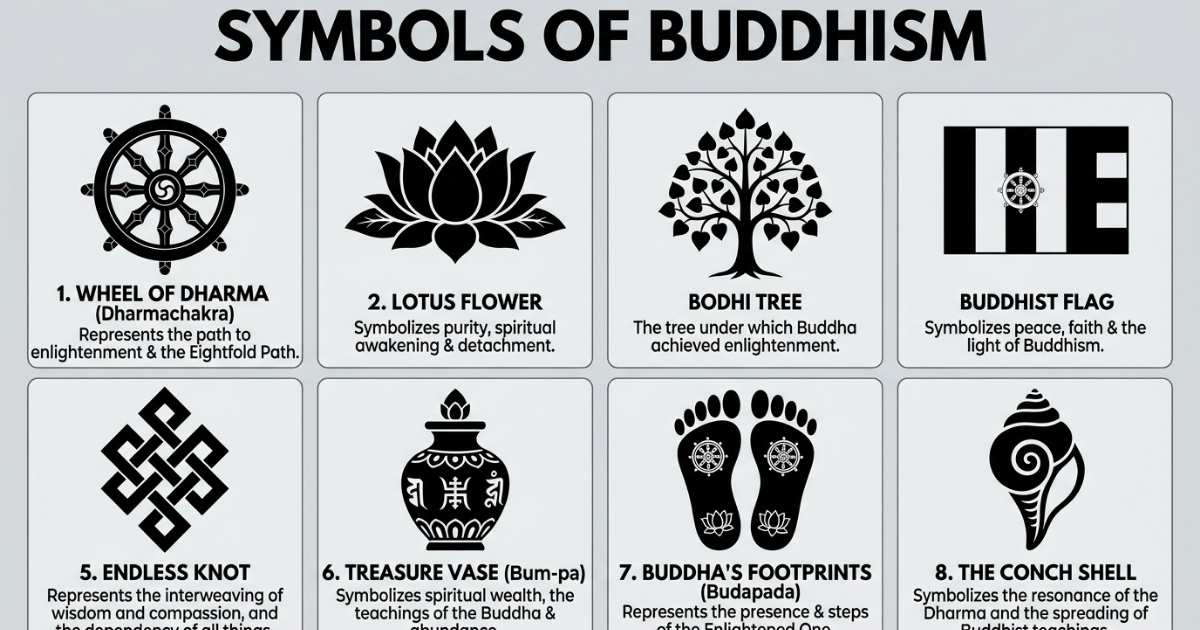
The eight symbols of Buddhism are known collectively as the Ashtamangala, or the Eight Auspicious Symbols. They appear widely in Tibetan, Nepali, and Chinese Buddhist traditions. These eight sacred signs are:
- The Dharma Wheel (Dharmachakra)
- The Conch Shell
- The Lotus Flower
- The Parasol (Umbrella)
- The Golden Fish
- The Treasure Vase
- The Endless Knot
- The Victory Banner
Each of these symbols carries a specific teaching that guides practitioners along the path to liberation.
8 Symbols Of Buddhism And What They Mean
The Dharma Wheel stands for the Buddha’s teachings and the Noble Eightfold Path. The Conch Shell represents the far-reaching sound of dharma. The Lotus Flower points to purity emerging from the mud of worldly existence. The Parasol symbolizes protection from suffering. The Golden Fish represents harmony and freedom. The Treasure Vase holds the nectar of immortality and spiritual wealth. The Endless Knot reflects the interconnected nature of all existence. The Victory Banner celebrates the triumph of wisdom over ignorance.
Together, these eight symbols map out the full journey from spiritual entry to complete awakening.
Symbols Of Enlightenment
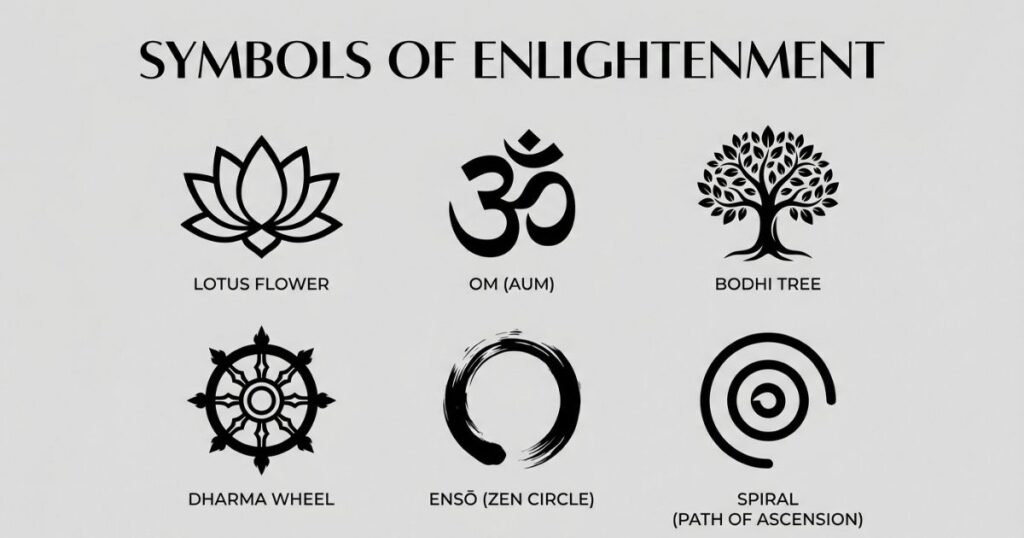
The most recognized symbols of enlightenment in Buddhism include the Bodhi Tree, the Lotus Flower in full bloom, and the Dharma Wheel in motion. Each points to a specific dimension of awakening. The Bodhi Tree marks the physical place where Siddhartha Gautama became the Buddha. The fully open lotus represents the mind freed from all defilements. The spinning Dharma Wheel shows that the teachings are alive, moving, and transforming all who encounter them.
Enlightenment Buddhist Symbols
Beyond these, the Enso circle from Zen Buddhism also stands as a powerful symbol of enlightenment. It is a hand-drawn circle created in one or two brushstrokes that captures the moment when the mind is fully free. Unlike most spiritual symbols, the Enso is never perfect, and that imperfection is precisely its teaching.
Zen Symbols And Meanings
Zen Buddhism embraces simplicity. Its symbols focus on stillness, emptiness, and direct experience. The Enso circle is the most recognized Zen symbol, representing wholeness, the infinite, and the void. The Daruma (Bodhidharma) figure represents perseverance and meditation. Ink brush art in Zen often carries symbolic weight, where negative space speaks as loudly as form. Zen symbols teach that clarity arises not from complexity but from letting go.
Read More: 88+ Powerful Life Symbols and Their Deep Meanings That Will Change Your Perspective
Types Of Buddhist Symbols In Culture And Practice
5 Symbols Of Buddhism
If you are new to Buddhist symbolism, these five are the most important to know:
- The Dharma Wheel
- The Lotus Flower
- The Bodhi Tree
- The Buddha Image
- The Endless Knot
Each of these five forms a foundational vocabulary for understanding Buddhist art, architecture, and spiritual life.
Symbols Buddhism
Buddhist symbols appear everywhere, from monastery ceilings to modern tattoo studios. They function as reminders, anchors for meditation, expressions of devotion, and artistic traditions passed down for centuries. No matter the form or setting, their purpose remains the same: to point the mind toward truth.
Simple Buddhist Symbols
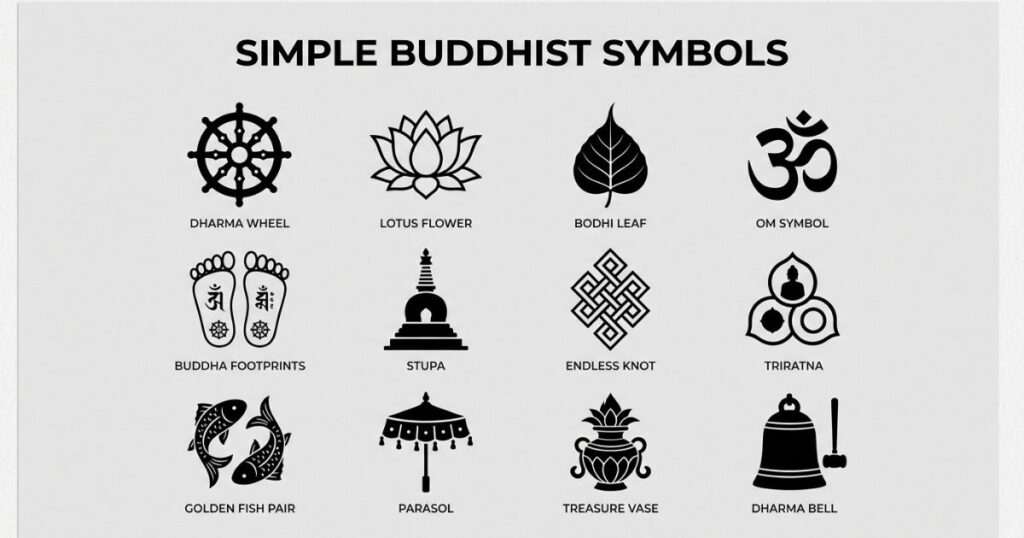
Not every Buddhist symbol is complex. Some of the most powerful are remarkably simple. A single lotus flower, a plain circle, or even a footprint of the Buddha can carry enormous spiritual depth. Simple symbols work because they leave room for the viewer’s own contemplation.
Buddhism Signs
Buddhism signs are visual expressions of faith. They appear in sacred spaces, on ritual objects, in architecture, and in personal practice. Common signs include the Dharma Wheel painted above temple doorways, the lotus carved into stone pillars, and the three jewels etched into prayer beads.
Buddha Signs
Signs associated directly with the Buddha include his footprint (Buddhapada), his hand gestures (mudras), and the Bodhi Tree. In early Buddhist art, before images of the Buddha as a human figure became common, these signs were used to represent his presence without depicting him directly. This approach honored his transcendence beyond physical form.
Sign For Buddhism
The universally recognized sign for Buddhism is the Dharma Wheel. It appears on the national flag of India, on the flags of many Buddhist organizations worldwide, and at the entrances of temples across Asia. Its eight spokes are immediately associated with the Noble Eightfold Path and Buddhist identity as a whole.
Symbol Of Buddhism
The primary symbol of Buddhism is the Dharmachakra, the Wheel of Dharma. It is the oldest, most widely used, and most recognized Buddhist symbol in the world. It predates even the image of the Buddha himself in Buddhist art history.
Buddhism Sacred Symbol
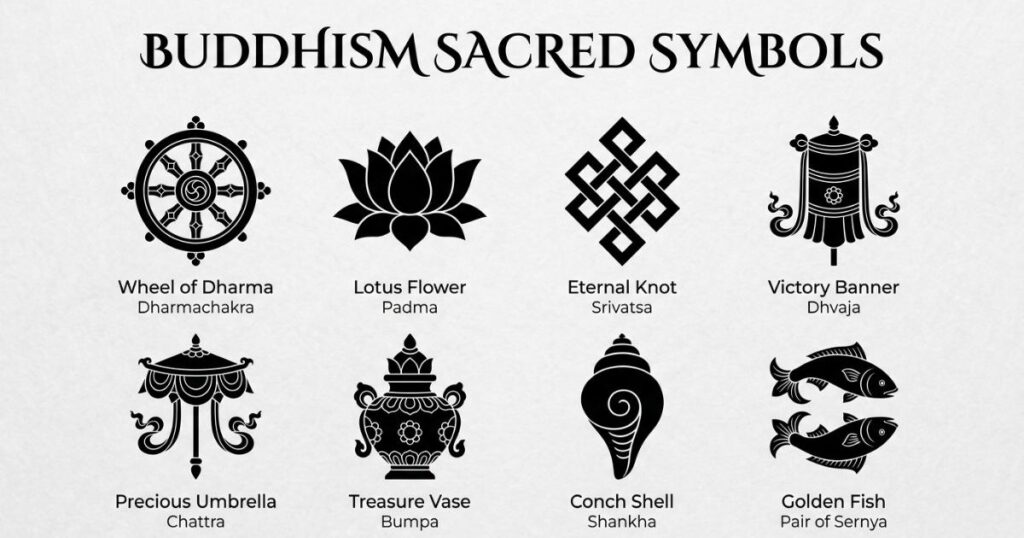
Among all sacred symbols, the lotus flower holds a uniquely beloved place. It is sacred because it visually embodies the entire spiritual journey: rooted in mud, growing through murky water, and blooming in pure beauty above the surface. Many teachers consider it the most spiritually complete symbol in all of Buddhist tradition.
Sacred Objects Of Buddhism
Sacred objects used in Buddhist practice include prayer beads (mala), offering bowls, incense, the vajra (thunderbolt scepter), the bell (ghanta), butter lamps, and stupas. Each of these physical objects carries symbolic meaning and is used in ritual to cultivate specific qualities like compassion, concentration, and wisdom.
Symbolism In Buddhist Life And Expression
Buddhist Symbolism
Buddhist symbolism is the organized use of sacred images to communicate dharma teachings. It is not merely decorative. Every color, gesture, posture, and object in Buddhist art carries meaning. A statue of the Buddha seated in meditation with one hand touching the earth, for example, depicts the moment of his enlightenment and the earth bearing witness to it.
Symbolism Buddhism
Symbolism in Buddhism functions on multiple levels simultaneously. On the surface, a symbol may simply identify a Buddhist space or person. On a deeper level, it invites the viewer into active contemplation of the teaching it represents. The most profound symbols work like doorways: passing through them, something shifts within the observer.
Symbols And Meanings Of Buddhism
The relationship between symbols and meanings in Buddhism is dynamic. A lotus does not mean just one thing. Its color changes its meaning. A white lotus represents mental purity. A pink lotus is associated with the historical Buddha. A blue lotus points to wisdom. A red lotus stands for love and compassion. This layered approach to meaning reflects the depth of Buddhist thought itself.
Buddhist Symbols And Their Meanings
Every major Buddhist symbol connects directly to a core teaching. The Dharma Wheel points to the Eightfold Path. The Endless Knot reflects interdependence. The Treasure Vase holds the inexhaustible wealth of the dharma. Understanding the meaning behind each symbol transforms viewing Buddhist art from passive observation into active spiritual engagement.
Buddhist Symbol Of Life
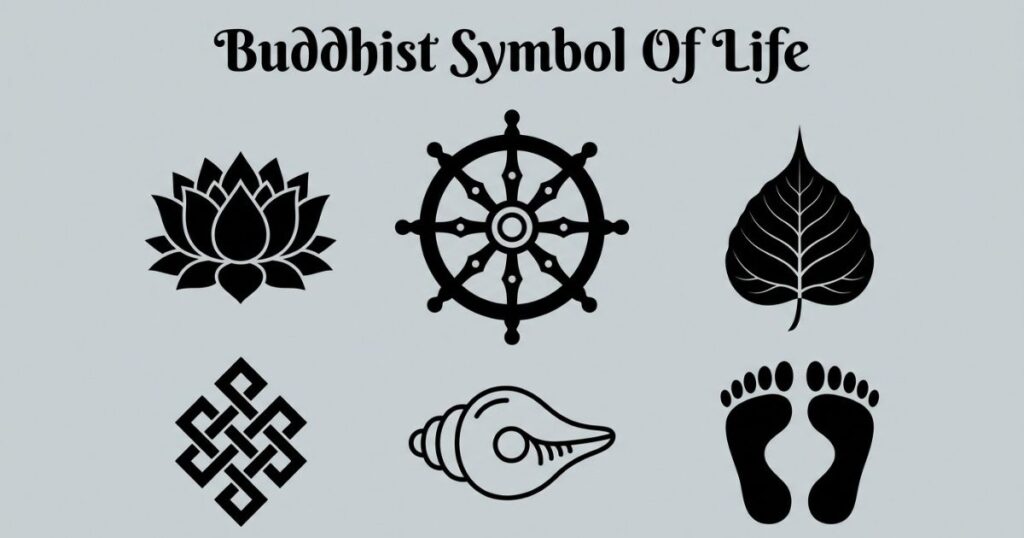
The Wheel of Life (Bhavachakra) is the Buddhist symbol of life in its fullest sense. It depicts the entire cycle of existence, showing the six realms of being, the forces that drive rebirth, and the path toward liberation. It is one of the most detailed and comprehensive symbols in Buddhist iconography.
Buddha Symbols Meaning
Buddha symbols point to qualities of an awakened mind: boundless compassion, penetrating wisdom, unshakeable equanimity, and freedom from all forms of suffering. Understanding what these symbols mean is the first step toward embodying what they represent.
Buddhist Symbol For Love
In Buddhism, love is inseparable from compassion (karuna) and loving-kindness (metta). The symbol most closely associated with compassionate love is the thousand-armed Avalokiteshvara (Guanyin in Chinese tradition). Each arm represents compassion reaching out to help a being in need. The lotus flower also carries associations of pure, selfless love.
Tibetan Buddhist Symbols
Tibetan Buddhism is especially rich in symbolism. Beyond the Eight Auspicious Symbols, Tibetan tradition includes the Vajra (indestructibility and enlightened power), the prayer wheel (accumulation of merit through mantra), the thangka paintings (detailed visual dharma teachings), and the mandala (cosmic diagram used in meditation and ritual). Tibetan symbols tend to be more complex, colorful, and layered than those of other Buddhist traditions, reflecting the depth of Vajrayana philosophy.
Buddha Symbols
Common Buddha symbols include the Dharma Wheel, lotus throne, Bodhi Tree, sacred footprint, hand gestures (mudras), and various expressions of the Buddha in art. Together they form a visual language that tells the entire story of the Buddha’s life and teachings without a single written word.
Buddhism Symbol Photo
When studying Buddhist symbols through images, pay attention to color, posture, and surrounding context. A symbol viewed in isolation may carry a general meaning, but the same symbol placed within a larger composition or ritual context often carries a far more specific teaching. Photography and art that capture Buddhist symbols in their natural settings, whether in temples, sacred gardens, or ritual practice, convey something that isolated studio images cannot.
Deep Symbolic Meaning of Buddhism Symbols
Spiritual Level
At the spiritual level, Buddhist symbols function as direct pointers to awakening. They are not objects of worship in themselves but windows into a deeper reality. The lotus is not just a beautiful flower. It is proof that purity is possible even in the most difficult conditions. The Dharma Wheel is not just a design. It is the living movement of truth through the world.
Psychological Level
Research has shown that the aesthetic perception of Buddhist symbols positively influences perceived happiness and life satisfaction. This is no accident. These symbols were designed over centuries to calm the nervous system, focus the mind, and redirect attention from reactivity toward awareness. The Enso circle, the symmetry of the Dharma Wheel, and the soft curves of the lotus are all visually soothing in ways that support meditative states.
Cultural Level
At the cultural level, Buddhist symbols serve as markers of identity, community, and shared values. Seeing a Dharma Wheel above a temple door signals that this is a place of teaching and refuge. A lotus carved into a monastery wall tells visitors that transformation is possible here. These symbols build a sense of belonging among practitioners across language and geographic barriers.
Types and Variations of Symbols of Buddhism
1. The Dharma Wheel (Dharmachakra)
The Dharma Wheel is the oldest and most important Buddhist symbol. Its eight spokes represent the Noble Eightfold Path, the practical guide to ethical conduct, mental discipline, and wisdom. The hub represents the concentrated mind. The rim holds everything together in unity. The wheel’s circular shape reflects the completeness of the dharma and the continuous turning of teachings in the world.
2. The Lotus Flower
The lotus grows in muddy water and rises above it to bloom in beauty. This natural process perfectly mirrors the human journey from confusion and suffering toward clarity and liberation. The stage of the lotus bloom represents the stage of the practitioner: closed bud for beginners, partially open for those on the path, fully bloomed for those who have awakened.
3. The Buddha Image
The image of the Buddha in human form became popular around the first century CE. Different postures and hand gestures carry specific meanings. The seated meditation posture represents concentration and inner stillness. The standing posture with one hand raised in the abhaya mudra represents fearlessness and protection. The reclining posture depicts the Buddha’s final passing into parinirvana.
4. The Endless Knot
The Endless Knot has no beginning and no end. It represents the interconnected nature of all phenomena, the inseparable relationship between wisdom and compassion, and the cycle of cause and effect known as karma. When contemplating the Endless Knot, practitioners are reminded that their practice does not exist in isolation. Every act of kindness and every moment of mindfulness ripples outward in ways that cannot be fully traced.
5. The Bodhi Tree
The Bodhi Tree is the sacred fig tree under which Siddhartha Gautama attained enlightenment after 49 days of meditation. The original tree still stands in Bodh Gaya, India, as a living symbol of awakening. The heart-shaped bodhi leaf has become a symbol of the potential that exists within every being to wake up. Pilgrims travel from around the world to sit beneath its branches and meditate.
Symbols of Buddhism Across Cultures
India
India is the birthplace of Buddhism, and Indian Buddhist symbols emphasize enlightenment, liberation from suffering, and the historical life of the Buddha. The Dharma Wheel, the Bodhi Tree, the sacred footprint, and the stupa are all prominent symbols in Indian Buddhist tradition.
China
Chinese Buddhism blended Buddhist symbolism with Taoist and Confucian ideas. The result is a tradition that emphasizes harmony, longevity, and balance alongside dharma teachings. Guanyin, the Bodhisattva of Compassion, became one of the most beloved figures in Chinese Buddhist symbolism, often depicted with the lotus and a vase of pure water.
Japan
Japanese Buddhism is home to Zen, which developed its own minimalist symbolic language. The Enso circle, calligraphic brushwork, the raked sand garden, and the simple pine tree all carry Zen teaching. Japanese Buddhist symbols tend toward elegant simplicity, finding the infinite within the ordinary.
Tibet
Tibetan Buddhism developed the most visually complex symbolic tradition in all of Buddhism. Thangka paintings, mandalas, the Wheel of Life, the vajra, prayer flags, and the Eight Auspicious Symbols are all central to Tibetan practice. Color is especially significant: each color in Tibetan iconography corresponds to a specific quality of awakened mind.
Southeast Asia
In countries like Thailand, Myanmar, Sri Lanka, and Cambodia, Buddhist symbolism centers on devotion, merit-making, and community. Temple architecture, Buddha images in royal postures, offering rituals, and the lotus figure prominently. The emphasis is on the living practice of Buddhism within everyday community life.
Symbols of Buddhism in Art, Movies and Pop Culture
Buddhist symbols have crossed into global popular culture in a significant way. The lotus flower appears in fashion design, tattoo art, and interior decoration worldwide. The Dharma Wheel appears in meditation apps and wellness brands. The Enso circle shows up in gallery art and minimalist home decor.
In film, Buddhist symbolism appears in movies like “Little Buddha,” “Kundun,” and “Spring, Summer, Fall, Winter… and Spring,” where the symbols carry genuine narrative and spiritual weight. In music, the Om syllable and Tibetan bowl sounds appear in albums designed to support meditation and stress relief.
This cultural spread has brought both opportunity and responsibility. When Buddhist symbols are used thoughtfully and with understanding, they spread genuine wisdom. When used carelessly, they risk losing their depth. The best approach is to learn what a symbol means before incorporating it into your life.
Spiritual and Dream Meaning of Symbols of Buddhism
When Buddhist symbols appear in dreams or during meditation, they often signal meaningful inner shifts. Dreaming of a lotus flower blooming is widely associated with spiritual opening and the emergence of clarity after a period of confusion. Seeing a Dharma Wheel in a dream may signal a call to return to practice or study. The Bodhi Tree in a dream often points to the need for stillness and patient waiting.
Many practitioners report feeling calm, guided, or spiritually energized after encountering Buddhist symbols in dreams or during meditation. While interpretations are personal and contextual, the consistent theme is movement toward awareness, compassion, and inner freedom.
Positive vs Negative Meaning
Positive Meaning
Buddhist symbols carry overwhelmingly positive meanings. They represent awakening over ignorance, compassion over selfishness, wisdom over confusion, and freedom over suffering. The lotus represents beauty rising from difficulty. The Dharma Wheel represents the dynamic, living power of truth. The Endless Knot reminds us that we are all connected in something larger than ourselves.
Negative Meaning
There are no inherently negative Buddhist symbols in the traditional sense. However, the improper use or cultural misappropriation of Buddhist symbols without understanding their meaning can be seen as disrespectful. Additionally, symbols like the Wheel of Life include depictions of suffering and the realms of difficulty, not as negative omens, but as honest representations of the full range of conscious experience that beings move through on the path toward liberation.
Why Humans Are Attracted to Symbols of Buddhism
The human mind is wired for symbols. We think in images, respond to patterns, and find meaning in visual forms. Buddhist symbols have endured for over two millennia because they speak to something universal in the human experience: the longing to be free from suffering, to love without conditions, and to know the truth of our existence.
These symbols also work because they are honest. They do not promise perfection or deny difficulty. The lotus grows in mud. The Wheel of Life includes realms of pain. The Bodhi Tree is home to insects as well as enlightened insight. This honesty is what makes Buddhist symbolism trustworthy and endlessly relevant.
Beyond philosophy, there is a practical dimension. Focusing on a Buddhist symbol during meditation gives the restless mind an anchor. It calms the nervous system, redirects attention, and creates conditions for clarity to arise naturally. In a world saturated with noise, these symbols offer a doorway into silence.
FAQ’s
What is the most important symbol of Buddhism?
The Dharma Wheel (Dharmachakra) is the most recognized and central symbol of Buddhism, representing the Buddha’s teachings and the Noble Eightfold Path.
What are the 8 auspicious symbols of Buddhism?
The eight auspicious symbols are the Dharma Wheel, Conch Shell, Lotus, Parasol, Golden Fish, Treasure Vase, Endless Knot, and Victory Banner, collectively known as the Ashtamangala.
What does the lotus flower represent in Buddhism?
The lotus represents spiritual purity and enlightenment, symbolizing the ability to rise above suffering and attachment just as the lotus blooms above muddy water.
What is the Buddhist symbol for enlightenment?
The Bodhi Tree, the fully bloomed lotus, and the Enso circle are all primary symbols of enlightenment in Buddhist tradition.
What does the Endless Knot mean in Buddhism?
The Endless Knot represents the interconnectedness of all things, the unity of wisdom and compassion, and the unending cycle of cause and effect.
Is the Om symbol Buddhist?
Om (Aum) originated in Hinduism but is shared in Buddhist practice, especially in Vajrayana and Tibetan Buddhism, where it appears in sacred mantras like “Om Mani Padme Hum.”
What do Tibetan Buddhist symbols mean?
Tibetan Buddhist symbols are richly layered visual teachings that combine spiritual protection, cosmic understanding, and guides to meditation and ethical conduct.
What is the Buddhist symbol for love?
Avalokiteshvara (Guanyin) and the lotus flower are the primary Buddhist symbols associated with compassionate love and universal kindness.
Conclusion
Symbols of Buddhism are far more than beautiful designs. They are living teachings that have guided seekers toward awakening for thousands of years. Whether you are drawn to the timeless simplicity of the lotus, the dynamic motion of the Dharma Wheel, or the quiet perfection of the Zen Enso circle, each symbol holds a doorway.
Understanding these sacred signs does not require formal study or religious conversion. It only requires genuine curiosity and a willingness to look inward. The next time you encounter a Buddhist symbol, pause. Ask what it is pointing toward. That small act of inquiry is itself the beginning of the path.

Christopher Davis is the pun-loving voice behind Giggles Magazines, serving quick laughs and clever wordplay with every post. He believes a good pun can brighten any day, and he’s here to prove it. 😄