
The Ku Klux Klan has used symbols for over 150 years to spread fear, enforce group identity, and recruit followers. These symbols are not random. They carry coded messages rooted in racial hatred, extremist ideology, and deliberately distorted religious imagery. Understanding what they mean and where they come from is critical for educators, historians, researchers, and communities working to combat hate.
This article breaks down the most well-known KKK symbols, their origins, their psychological functions, and why recognizing them still matters today.
What Are KKK Symbols?
KKK symbols are visual markers used by the Ku Klux Klan to communicate ideology, signal membership, and intimidate targeted communities. They include crosses, robes, flags, hand gestures, seals, and coded emblems. These symbols function as a shared language within white supremacist networks and as tools of psychological terror toward outsiders.
The organization itself was founded in 1865 by Confederate veterans in Pulaski, Tennessee. The name “Ku Klux” derives from the Greek word “kyklos,” meaning circle, combined with “Klan,” referencing the Scottish and Irish term for family. From the beginning, the group leaned on visual symbolism to build identity and project power.
Common Klan Symbols And Signs
Klan Symbols
The most recognizable Klan symbols fall into a few core categories: burning crosses, white robes with pointed hoods, the Blood Drop Cross emblem, and various flags and banners. Each carries its own layered meaning, though all share the same ideological foundation of white supremacy and racial terror.
KKK Symbol
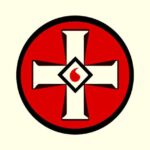
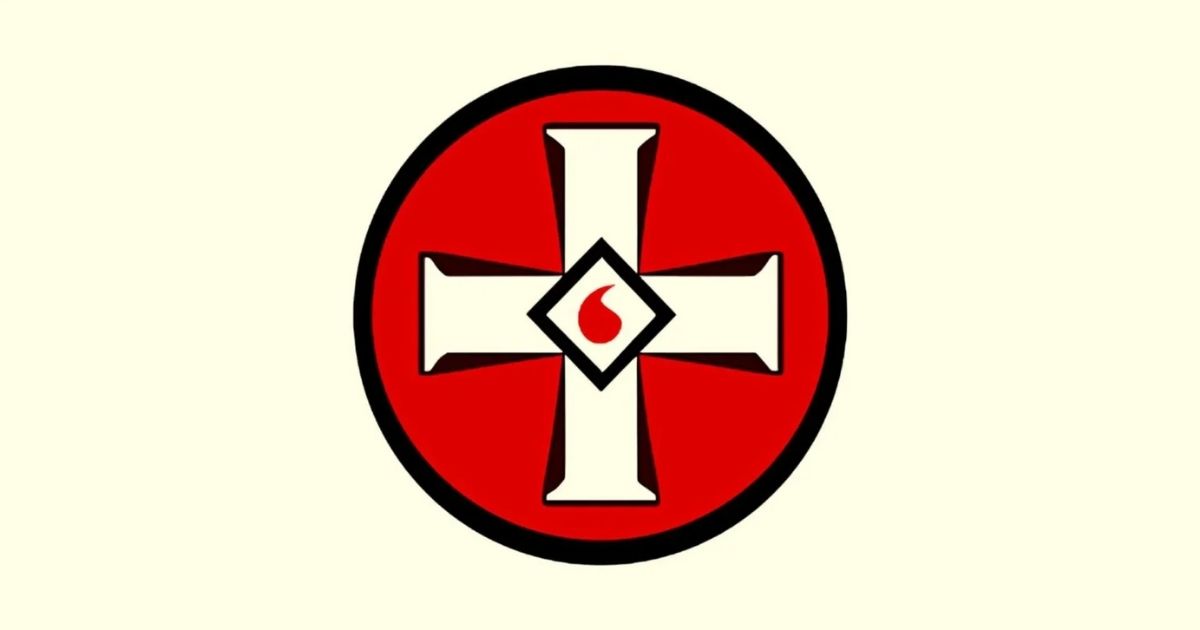
When people refer to the “KKK symbol” in a general sense, they are usually referring to the Blood Drop Cross, officially known among Klan members as the MIOAK, or Mystic Insignia of a Klansman. This emblem appears as a white cross on a circular red background, outlined in black. It appears on robes, flags, membership materials, and printed propaganda.
Read More: 65+ Mysterious Filipino Symbols and Their Hidden Meanings You’ve Never Noticed
Blood Drop Cross
The Blood Drop Cross has an origin that even most Klan members do not know. According to research by the Anti-Defamation League, it began in the early 20th century as four letter “K” shapes arranged in a square formation, with a yin-yang symbol at the center. Over time, the letters shifted into a cross shape and the light portion of the yin-yang disappeared, leaving only a colored drop that came to resemble blood. Members eventually interpreted this red drop as blood shed in defense of the white race, though that meaning was assigned after the visual transformation, not before.
Ku Klux Klan Symbol
The broader set of Ku Klux Klan symbols includes burning crosses, pointed hoods, flags bearing crosses and patriotic colors, and the six-sided star formation sometimes used in Klan iconography. The KKK has also borrowed symbols from other hate movements, including some Nazi-era imagery, particularly as different Klan factions merged with neo-Nazi organizations during the 1970s and 1980s.
KKK Sign
The term “KKK sign” can refer to the general visual identity of the group, including the letters “KKK” themselves displayed on robes, banners, or burned into property as an act of intimidation. The initials alone, in certain historical contexts, functioned as a warning to targeted communities that violence could follow.
KKK Hand Sign
No single hand sign is universally recognized as an official Klan gesture in documented historical records. However, extremist researchers and hate group monitoring organizations note that certain white power hand gestures are used in overlapping circles, including among groups aligned with Klan ideology. Context and combination with other signals are key when identifying such gestures.
Klu Klux Klan Symbol
The alternate spelling “Klu” rather than “Ku” is a common misspelling but often appears in searches for the same core symbols. The symbols associated with the group remain identical regardless of spelling variation. The Blood Drop Cross, burning cross, and white robes are the foundational visual identifiers across all variations of the name.
Identity, Emblems And Recognition
Does The KKK Have A Symbol?
Yes. The KKK has a well-documented set of symbols that have evolved across three major iterations of the organization. The primary emblem is the Blood Drop Cross. Secondary symbols include the burning cross, white robes with pointed hoods, and various flags and seals used by different Klan chapters.
KKK Emblem
The official KKK emblem, the Blood Drop Cross, functions as the organizational logo. It appears on membership cards, robes, banners, and ceremonial items. Its circular red field, white cross, and dark outline create an immediately recognizable visual identity within extremist circles, and a widely condemned symbol of hate outside them.
Ku Klux Klan Symbols
The full range of Ku Klux Klan symbols includes the burning cross, white robes and hoods, the Blood Drop Cross, flags combining patriotic imagery with Klan iconography, the Confederate battle flag (used as a secondary symbol), and coded membership tokens. Historical records from the Nebraska State Historical Society document how membership medallions from the 1920s incorporated the Constitution, the Bible, and the US flag under the slogan “ONE COUNTRY, ONE FLAG, ONE LANGUAGE,” claiming these beloved national symbols for the Klan’s own agenda.
KKK Symbols And Meanings
Each symbol carries specific meaning within Klan culture. The burning cross represents terror masked as religious conviction. The white robes signal anonymity, false purity, and collective racial identity. The Blood Drop Cross encodes claims of racial sacrifice. Flags communicate territorial presence and ideological allegiance. Together, these symbols create a visual vocabulary of supremacy and intimidation.
What Is The KKK Symbol?
The primary KKK symbol is the Blood Drop Cross, also known as the MIOAK. It is a square white cross within a circular red background, outlined in black. Secondary symbols include the burning cross and the white pointed hood, both of which have become globally recognized markers of Klan activity and white supremacist ideology.
Rituals And Symbolic Actions
Why Do The KKK Burn Crosses?
The practice of burning crosses is one of the most powerful and misunderstood aspects of Klan ritual. Contrary to what many assume, cross burning was not part of the original Klan founded after the Civil War. The practice was introduced by the second Klan, which emerged in 1915, and it was directly inspired by a scene in D.W. Griffith’s film “The Birth of a Nation.” That film drew from Thomas Dixon Jr.’s novel “The Clansman,” which romanticized the Scottish Highland tradition of fire crosses as a call to arms.
William Joseph Simmons, who revived the Klan in 1915, adopted the burning cross wholesale from the film. It became a centerpiece of Klan gatherings, accompanied by hymns, prayer, and the overtly religious framing the second Klan favored. In practice, however, burning crosses were placed outside the homes of Black families, civil rights activists, Catholics, and Jews as acts of pure intimidation. The ritual fused religious imagery with racial terrorism in a way designed to amplify psychological impact.
As cross burnings grew in number and visibility during the Klan’s expansion in the 1920s, the practice became a tool of both internal solidarity and external terror. It communicated to targeted communities that they were being watched, and to Klan members that collective violence was sanctioned and organized.
Visual Representations And Media
KKK Symbols AC
This phrase often refers to archived or categorized collections of Klan symbols used in academic research, legal documentation, and counter-extremism work. Organizations like the Southern Poverty Law Center and the Anti-Defamation League maintain detailed archives of hate symbols, including KKK imagery, to support educators, law enforcement, and researchers.
KKK Symbols Images
Images of KKK symbols appear extensively in historical records, documentary films, museum collections, and educational materials. They serve as primary source evidence for understanding how the Klan operated, recruited, and intimidated communities. Viewing these images in a historical and educational context is fundamentally different from reproducing or glorifying them.
KKK Symbols Pictures
Photographs of KKK symbols in use, on robes, displayed at rallies, burned into property, or printed on propaganda materials, provide critical visual documentation of the Klan’s reach and tactics. Archives at institutions such as the Library of Congress and various civil rights museums preserve these records as evidence of historical atrocities and ongoing threats.
The KKK Symbols
The full body of KKK symbols, taken together, forms a visual system designed to communicate one consistent message: racial hierarchy enforced through fear. From the smallest membership token to the largest cross-lighting ceremony, every symbol in the Klan’s repertoire was designed to build internal cohesion while projecting external dominance.
Read More: 88+ Powerful Life Symbols and Their Deep Meanings That Will Change Your Perspective
Variations And Types Of Symbols
Different KKK Symbols
Over the course of three distinct Klan eras, the organization’s symbolism shifted and expanded. The first Klan, active during Reconstruction, used simpler iconography. The second Klan, which peaked in the 1920s with millions of members, developed the elaborate symbolic vocabulary still associated with the group today. The third Klan, active from the 1950s onward, incorporated Nazi imagery and symbols as certain factions merged with neo-Nazi movements.
KKK Symbols And Flags
Flags used by various Klan chapters incorporated crosses, patriotic colors, and organizational slogans. Some featured the Confederate battle flag. Others displayed the Blood Drop Cross against colored backgrounds. These flags were flown at gatherings, marches, and rallies, functioning as territorial and ideological markers. Their display in public spaces has been the subject of legal challenges and community protests across the United States.
Deep Symbolic Meaning
Spiritual Level
On a spiritual level, KKK symbols consistently distort religious imagery to serve an ideology of domination. The cross, a central symbol of Christian compassion and redemption, is stripped of those meanings and transformed into an object of racial terror. The burning cross does not represent faith but its weaponization. This misappropriation of sacred imagery is not incidental; it reflects the Klan’s deliberate strategy of cloaking racial violence in the language of divine authority.
Psychological Level
Psychologically, KKK symbols function on two audiences simultaneously. For members, they create belonging, hierarchy, and a sense of shared mission. For targeted communities, they are instruments of fear designed to produce self-censorship, displacement, and psychological harm. The anonymity afforded by the white hood removes individual accountability while amplifying collective menace. This combination, identity for the perpetrator, terror for the victim, is the core psychological engineering of Klan symbolism.
Cultural Level
Culturally, KKK symbols represent oppression, exclusion, and historical injustice. They are reminders of how visual language can be weaponized to reinforce systems of racial inequality. For Black Americans and other targeted communities, these symbols carry the weight of lived experience across generations. For broader American culture, they represent a shadow history that cannot be erased, only understood and resisted.
Types and Variations of KKK Symbols
The Burning Cross
The burning cross is arguably the most internationally recognized symbol of the Klan. Visually, it is a large wooden cross set on fire. Its meaning is intimidation and terror dressed in the language of religious authority. It appears in historical photographs, documentary footage, and civil rights records as evidence of organized racial violence.
The Blood Drop Cross
Appearing as a red drop centered within a square white cross on a circular red background, the Blood Drop Cross encodes the Klan’s claims of racial sacrifice and supremacist ideology. It appears on Klan flags, robes, and printed membership materials. Despite its religious appearance, its origin has nothing to do with Christian theology.
White Robes and Hoods
The white robes and pointed hoods worn by Klan members represent anonymity, false purity, and group identity. The hood hides the individual while reinforcing the collective. Interestingly, researchers have noted that similar garments, called capirotes, were worn by Spanish penitents during Holy Week since the 1400s, pointing to how symbols with entirely different origins can be co-opted to serve radically different purposes.
Klan Emblems and Seals
Klan chapters used various circular seals, often incorporating crosses, patriotic slogans, and organizational titles. These appeared on official documents, banners, and ceremonial insignia. They communicated internal authority and organizational structure, mapping the Klan’s rigid hierarchy onto physical objects.
KKK Symbols Across Cultures
Outside the United States, KKK symbols are viewed almost universally as imported extremist hate imagery. In Europe, their display is restricted or banned under hate speech laws in many countries. In academic and policy contexts globally, they are studied as examples of how visual propaganda facilitates radicalization. In digital spaces, they serve as coded signals within white nationalist networks. The meaning across cultures is overwhelmingly negative, representing racial violence, political extremism, and systematic terror.
KKK Symbols in Art, Movies, and Pop Culture
Films and literature have used KKK symbols extensively to portray evil, injustice, and historical trauma. “The Birth of a Nation” (1915) was responsible for reviving the Klan and popularizing the burning cross as a Klan symbol. Later films such as “BlacKkKlansman” and documentary series have re-examined this imagery critically, exposing the Klan’s violence and hypocrisy. Artists and activists have also reframed Klan symbols in counter-narratives designed to strip them of their power and expose their absurdity. In fashion and tattoo culture, the appearance of such symbols consistently triggers social rejection and legal consequences.
Spiritual and Dream Meaning of KKK Symbols
When KKK symbols appear in dreams or meditative contexts, mental health professionals and cultural analysts suggest they typically reflect inner conflict, fear, unresolved trauma, or confrontation with injustice. They do not carry any positive spiritual significance. For individuals from communities historically targeted by the Klan, encountering these symbols, even in dreams, can trigger trauma responses. For others, they may represent a confrontation with complicity or moral responsibility.
Positive vs Negative Meaning
There is no positive meaning rooted in the original intent of KKK symbols. Any attempt to reframe or rehabilitate these symbols ignores the documented harm they represent. Their meaning is not abstract; it is defined by lived history, organized violence, and generational trauma inflicted on real communities. Unlike some symbols that carry dual meanings across different contexts, KKK symbols were created specifically to intimidate and harm. That context is inseparable from the image.
Why Humans Are Drawn to Symbols Like These
Humans are neurologically wired to respond to symbols. Symbols simplify complex ideas into immediate, emotionally resonant images. Extremist groups exploit this instinct deliberately, using symbols to build identity, manufacture loyalty, and create the psychological conditions for collective violence. The Klan’s symbolic vocabulary was not accidental; it was engineered to produce fear in outsiders and fervor in members. Understanding the mechanisms of symbolic manipulation is one of the most effective tools for resisting radicalization and recognizing extremist recruitment.
FAQ’s
What does the KKK Blood Drop Cross actually represent?
It originated from four “K” letters arranged in a square, later misread as a cross with a blood drop at its center, which members reinterpreted as blood shed for the white race.
Is it illegal to display KKK symbols?
Laws vary by country. Many European nations restrict such displays under hate speech laws, while in the US, display is often protected speech but can constitute a hate crime depending on context and intent.
Why did the KKK start burning crosses?
The practice began with the second Klan in 1915, adopted directly from a scene in the film “The Birth of a Nation,” and was used as a ritual of intimidation against targeted communities.
Are KKK symbols still used today?
Yes, primarily within far-right extremist circles, online white nationalist networks, and isolated domestic hate groups, though the Klan’s organized membership has declined sharply.
Do KKK symbols have any religious legitimacy?
No. Mainstream Christian denominations have consistently rejected and condemned the Klan’s misappropriation of Christian imagery, including the cross.
What should I do if I see a KKK symbol displayed publicly?
Report it to local law enforcement and contact organizations such as the ADL or SPLC, which track hate incidents and can provide guidance and resources.
Conclusion
KKK symbols are not relics of a distant past. They are active tools in modern extremist networks, and understanding them is a prerequisite for countering them. From the Blood Drop Cross to the burning cross to the white hood, each symbol encodes a specific ideology of racial terror and supremacist identity. Recognizing these symbols, understanding their origins, and knowing how to respond when they appear is not just a historical exercise. It is an act of civic responsibility. Education, documentation, and clear public condemnation remain the most effective responses to the continued presence of hate symbolism in public and digital life.

Christopher Davis is the pun-loving voice behind Giggles Magazines, serving quick laughs and clever wordplay with every post. He believes a good pun can brighten any day, and he’s here to prove it. 😄