
Have you ever looked at a Philippine peso bill and noticed the graceful curved script printed across it? Or seen a tattoo covered in geometric tribal patterns and wondered what story it tells? Filipino symbols carry centuries of history, spirituality, and cultural pride within their lines and shapes. From the sacred Baybayin characters used before Spanish colonization to the mythical Sarimanok bird of Maranao art, every symbol speaks a language deeper than words.
The Philippines is an archipelago of more than 7,000 islands, and each region developed its own visual language rooted in nature, ancestry, and belief. These symbols did not disappear with colonization. They survived, adapted, and are experiencing a powerful revival today. This article takes you deep into the world of Filipino symbols, their origins, spiritual significance, and why they continue to captivate people around the world.
What Are Filipino Symbols?
Filipino symbols are visual markers, patterns, scripts, and emblems that represent the values, beliefs, history, and identity of the Filipino people. They come from two broad traditions: pre-colonial indigenous culture and the national identity built after independence.
Pre-colonial Filipino society did not lack sophistication. When Spanish colonizers arrived in the 16th century, they were reportedly surprised to find that most Filipinos were already literate, using indigenous scripts for poetry, records, and letters. Symbols were woven into textiles, carved into gold jewelry, marked on skin through tattooing, and painted on pottery.
Today, Filipino symbols serve both as cultural reminders and as living expressions of pride. You find them on clothing, in street murals, in tattoos, in literature, and in government seals. They are the visual fingerprints of an entire civilization.
Read More: Angelic Symbols and Their Hidden Meanings That Have Guided Humanity for Centuries
Filipino Cultural Symbols And Their Meanings
Filipino Symbols and Meanings
Filipino symbols draw meaning from three deep sources: nature, community, and the spirit world. The sun represents freedom and enlightenment. Waves stand for adaptability and the sea-faring heritage of island people. Geometric diamond and triangle patterns in indigenous weaving traditions point to the cycles of life, death, and renewal.
Color also carries meaning. Red signals bravery and sacrifice. Blue represents peace and wisdom. White communicates purity and equality. Gold or yellow stands for richness, both spiritual and material.
Filipino Flag
The Philippine flag is perhaps the most widely recognized Filipino symbol in the world. Adopted on June 12, 1898, it features a horizontal bicolor of blue and red, with a white triangle at the hoist. Inside the triangle sits a golden sun with eight rays and three five-pointed stars.
Each element carries weight. The blue stripe stands for peace, truth, and justice. The red stripe represents patriotism and the valor of those who fought for independence. The white triangle embodies equality and fraternity. The golden sun with eight rays honors the eight provinces that first rose up against Spanish rule. The three stars represent the country’s three major island groups: Luzon, Visayas, and Mindanao. When the country is at war, the flag is flown with the red side up.
Filipino Symbol Tattoos
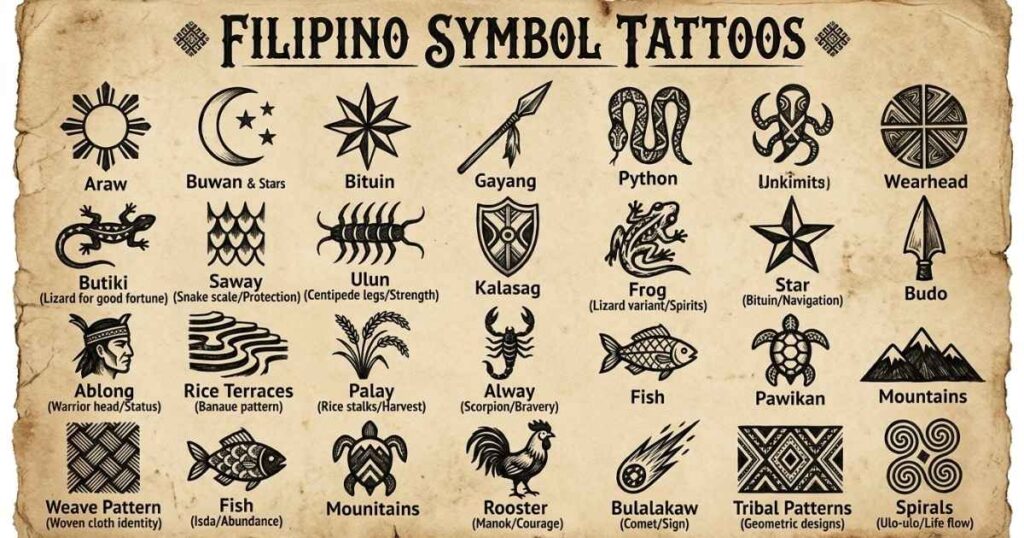
Tattooing in the Philippines is one of the oldest recorded art forms in Southeast Asia. The Spanish called the Visayan people “Los Pintados,” meaning “the painted ones,” because of their extensive body tattoos. These were not mere decoration. Tattoo patterns marked social rank, spiritual power, and warrior achievement.
Patterns typically featured animals like the Philippine eagle and crocodile, geometric shapes symbolizing cosmic order, and flowing designs representing water and wind. Today, Filipino symbol tattoos have seen a massive revival. Young Filipinos and members of the diaspora are returning to these designs to reconnect with their ancestry and cultural roots. Each tattoo tells a personal and communal story simultaneously.
Filipino Symbol Letters
When people refer to Filipino symbol letters, they are most often speaking of Baybayin, the pre-colonial writing system of the Philippines. Each character in Baybayin represents a syllable rather than a single letter, making it an alphasyllabary. The name comes from the Tagalog root word “baybay,” which means “to spell.”
Baybayin was used across Luzon and parts of the Visayas before Spanish rule gradually replaced it with the Latin alphabet. Today, Baybayin appears on the Philippine peso bills, in government proposals, on clothing, and in tattoos as a symbol of cultural pride and indigenous identity.
Philippines Symbols and Meanings
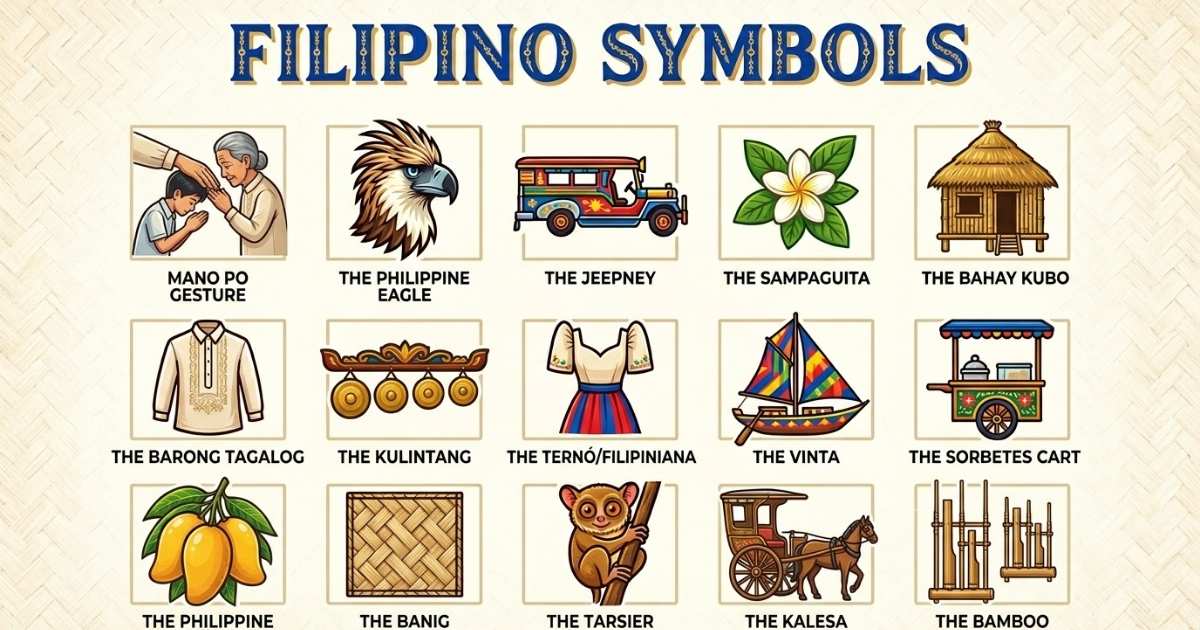
Philippine symbols span from official state emblems to community-held cultural icons. The national flag and great seal are formally defined. The Sampaguita flower, the Philippine Eagle, and the Narra tree also hold official national symbol status. Informally, the Carabao (water buffalo) is recognized as the national animal, representing the hardworking spirit of the Filipino farmer.
National Symbols Of The Philippines
What Are the 10 National Symbols of the Philippines
The official national symbols of the Philippines, established through law under Republic Act 8491 and other legislation, include the following:
The national flag is the primary symbol of sovereignty. The national anthem “Lupang Hinirang” is the musical representation of nationhood. The Great Seal, featuring the sun, stars, and other historical elements, is used on official government documents. The national language, Filipino (based on Tagalog), serves as a unifying symbol across more than 170 regional dialects. The Sampaguita is the national flower, chosen for its purity and fragrance. The Philippine Eagle is the national bird. The Narra is the national tree. The Philippine Pearl is the national gem. Arnis, the indigenous martial art using sticks and blades, is the national sport. Filipino Sign Language holds recognition as the national sign language.
Philippine National Symbols PDF
Educational materials on Philippine national symbols are widely distributed through the Department of Education and the National Historical Commission of the Philippines. These PDFs and learning materials are used in schools nationwide to help students connect visual symbols with historical context. They typically feature images of each symbol alongside detailed descriptions of their historical and cultural significance.
Read More: 88+ Powerful Life Symbols and Their Deep Meanings That Will Change Your Perspective
Philippines National Bird
The Philippine Eagle (Pithecophaga jefferyi) is one of the largest and most powerful eagles in the world. It is also one of the most endangered. The eagle stands as a symbol of strength, freedom, and the Filipino people’s vision for sovereignty and resilience. Found primarily in Mindanao, it is a critically protected species and a source of immense national pride.
Philippine National Symbols With Pictures and Description
Visual learning resources that show pictures of each national symbol alongside descriptions are popular in Philippine classrooms. These materials help make abstract cultural identity tangible. Seeing the Philippine Eagle, Narra tree, and Sampaguita flower side by side reinforces pride in natural heritage.
National Tree of the Philippines
The Narra tree (Pterocarpus indicus) is the national tree of the Philippines. It is prized for its golden-yellow wood, which is both durable and beautiful. The Narra tree represents the strength, resilience, and enduring character of the Filipino people. It was officially recognized as a national symbol because of its wide distribution across the archipelago and its deep roots in Filipino craftsmanship and culture.
Ancient And Traditional Filipino Symbols
Ancient Filipino Symbols
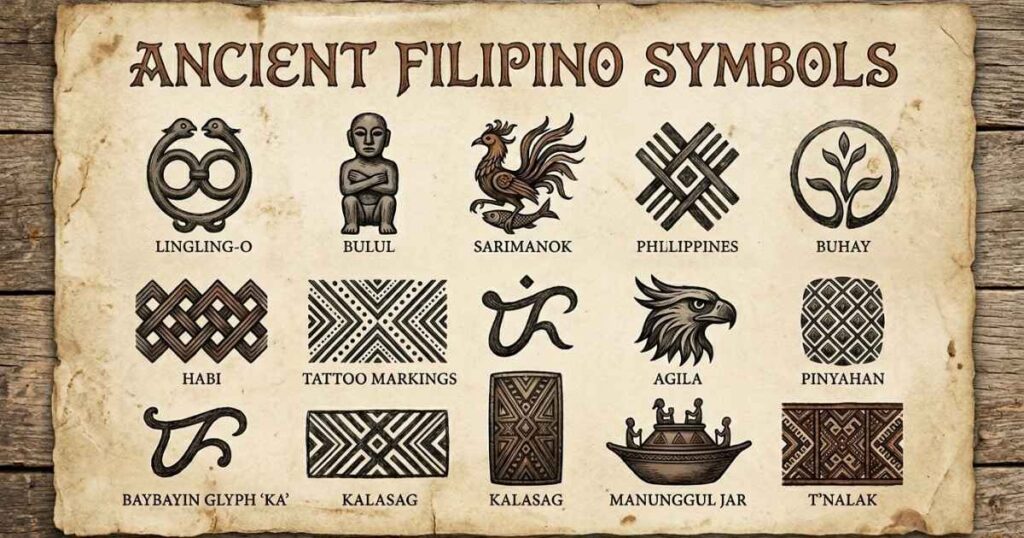
Ancient Filipino symbols emerged from a society deeply connected to the natural world and the spirit realm. Before written history, Filipinos communicated meaning through visual culture: tattoos, pottery, jewelry, and carvings. Archaeological findings in Tabon Cave in Palawan, including the famous Manunggul Jar, reveal that as far back as 5,000 years ago, early Filipinos used symbolic art to express beliefs about life, death, and the afterlife.
The Manunggul Jar features scrollwork resembling ocean waves along its upper body and a lid topped with two figures in a boat, representing the soul’s journey into the afterlife. It is now a national treasure and one of the most powerful examples of ancient Filipino symbolism.
Filipino Symbolism
Filipino symbolism operates on multiple layers. On the surface, a sun symbol represents warmth and light. On a deeper level, it represents freedom, divine energy, and national identity. A serpent or crocodile in indigenous art may represent danger but also power and transformation. Water symbols speak to the island people’s relationship with the sea, their source of life and migration.
This layered quality is central to understanding Filipino symbolic thought. Nothing means just one thing. Every symbol exists within a web of relationships between the human, natural, and spiritual worlds.
Traditional Filipino Symbols
Traditional symbols include the Okir patterns of Mindanao, the weaving designs of the T’boli people, the tattoo art of the Kalinga, and the script of Baybayin. The T’nalak, a woven cloth made by the T’boli tribe from Manila hemp, uses red, black, and white patterns that carry deep ceremonial and spiritual meaning. Traditionally, T’nalak was used in bridal ceremonies and as a medium of barter.
Filipino Good Luck Symbols
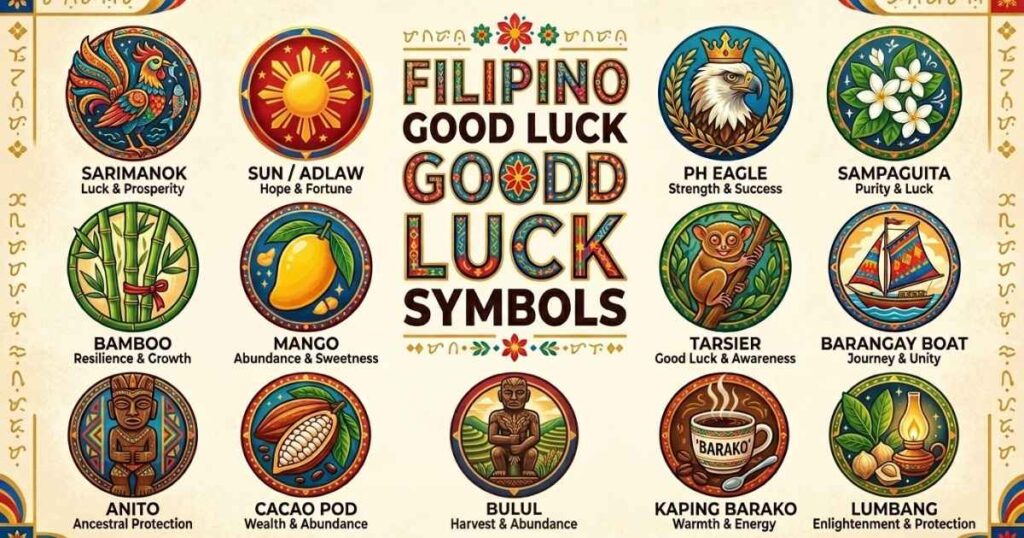
Several Filipino symbols are specifically associated with good fortune. The Sarimanok, a mythical colorful bird of Maranao culture, is perhaps the most recognizable. Whoever catches the Sarimanok is said to receive good luck and prosperity. The Sampaguita flower is also considered auspicious, often used as offerings and garlands during celebrations. Jade ornaments, found in ancient burial sites, were once considered prestige objects tied to spiritual protection and status.
Filipino Ancient Symbols for Strength
The Philippine Eagle was revered by indigenous communities as a symbol of power and dominance. The carabao represented endurance and the ability to keep going under hardship. Warrior tattoos depicting spears, ocean waves, and animal motifs were ancient Filipino symbols for strength worn directly on the body as both spiritual armor and social proof of bravery in battle.
Filipino Indigenous Symbols
Indigenous Filipino symbols vary significantly by ethnic group. The Ifugao of the Cordillera use intricate geometric weaving patterns tied to rice culture and ancestor worship. The Kalinga use tattoo art called “batok” to mark life milestones and tribal belonging. The Maranao of Mindanao use Okir, a flowing pattern of foliage and geometric spirals, across architecture, clothing, and ceremonial objects. The Mangyan of Mindoro use the Hanunuo script, one of several indigenous scripts related to Baybayin still in use today.
Filipino Protection Symbols
Protection was a central concern in pre-colonial Filipino spirituality. Anito figures, small carved idols representing ancestral spirits, were kept in homes for protection and guidance. Warrior tattoos served as spiritual armor. Certain plants and flowers held protective qualities in folk belief. Amulets called “anting-anting” were worn by warriors and ordinary people alike, believed to grant invulnerability and divine protection.
Filipino Symbols Of Identity, Culture And Strength
Family Filipino Symbols and Meanings
Family is the cornerstone of Filipino culture, and many symbols reflect this. The Bahay Kubo, or nipa hut, is a powerful symbol of community and family life. It represents the concept of “bayanihan,” the Filipino tradition of neighbors helping one another, often depicted by people collectively carrying a house to a new location. This spirit of communal solidarity defines Filipino family values at the deepest level.
Filipino Symbols for Strength
Strength in Filipino symbolism is not purely physical. It encompasses moral courage, spiritual resilience, and communal solidarity. The Narra tree, the Philippine Eagle, the carabao, and warrior tattoo patterns all express different dimensions of strength. The Baybayin script also symbolizes intellectual and cultural strength, representing a literacy tradition that predates Spanish influence by centuries.
Symbols That Represent Filipino Culture
The most widely recognized symbols of Filipino culture include Baybayin script, the Philippine flag, the Sampaguita flower, the Sarimanok bird, traditional weaving patterns, the Bahay Kubo, and Arnis as a martial art. Collectively, these symbols communicate a culture that is deeply connected to nature, community, spirituality, and resilience through hardship.
Filipino Culture Symbols
Every major aspect of Filipino life has a symbolic counterpart. Birth, marriage, harvest, war, and death each had their own visual language in indigenous communities. Today, these symbols have been preserved through folk art, weaving, tattoo revival movements, and the growing interest in pre-colonial Philippine culture among younger generations.
Indigenous Symbols of Filipino Identity
Indigenous Filipino identity is expressed through script, textiles, body art, and oral tradition made visual. The Baybayin script, the batok tattoos of Kalinga women, the Okir patterns of Mindanao, and the weaving traditions of mountain peoples are all living symbols of identity that refuse to disappear despite centuries of colonial pressure.
More Ancient And Cultural Filipino Symbols
Ancient Filipino Symbols and Meanings
The Manunggul Jar with its wave scrollwork represents the journey of the soul. The sun motif on ancient gold jewelry represents divine power and cosmic order. Crocodile carvings found on wooden artifacts represent fearlessness and connection to primordial forces. Serpent imagery in various cultures of the archipelago represents transformation and the cycle of rebirth.
Filipino Cultural Symbols
Cultural symbols include both the grand and the everyday. The jeepney, originally repurposed from American military vehicles left after World War II, became a colorful symbol of Filipino creativity and resilience. The Barong Tagalog, the formal shirt worn by Filipino men, represents elegance and national pride. The parol, the bamboo and paper star lantern lit during the Christmas season, symbolizes hope and the guiding light of faith.
Ancient Filipino Symbols for Strength
Among the Visayans, tattoo patterns covered the entire body of a proven warrior. Each mark was earned through acts of courage. These visual records of strength could not be faked or stolen. Among the Igorot peoples, warrior shields and headhunting rituals had their own symbolic vocabulary tied to ideas of honor, strength, and cosmic balance.
Filipino Symbols for Family
The Bahay Kubo represents familial togetherness. The sampaguita garland used in greetings and offerings symbolizes the warmth and welcome Filipino families extend to guests. The concept of “kapwa,” meaning shared identity or the recognition of the self in others, is perhaps the deepest symbolic value in Filipino culture, shaping how families and communities relate to one another.
Traditional Filipino Symbols and Meanings
Traditional symbols were never purely decorative. They encoded social rules, spiritual beliefs, and historical memories. A specific weaving pattern in T’nalak cloth identified the weaver’s community. A tattoo pattern among the Kalinga told the story of the wearer’s life. Baybayin characters recorded both practical records and intimate poetry. Every mark carried weight.
Old Filipino Symbols for Strength
Some of the oldest strength symbols come from the oral literature and epics of indigenous communities. The Maranao epic “Darangen” and the Ifugao epic “Hudhud” contain symbolic language about heroism, divine favor, and the power to overcome adversity. These epics were passed down for generations as living documents of what strength truly means.
Common Filipino Symbols
Common symbols seen across Philippine culture include the sun, stars, sampaguita, Philippine eagle, Baybayin characters, the cross (introduced through Spanish Catholicism), the jeepney, rice terraces, and the parol Christmas lantern. Each of these speaks to a different layer of Filipino history and identity.
Filipino Symbols and Practices
Symbols in Philippine culture are inseparable from practice. The Sarimanok is not just an image. It is performed in Maranao dance and music. Baybayin is not just a visual script. It is written, taught, and worn on skin. The parol is not just a decoration. It is made by hand and hung with intention. Filipino symbols live in action, not just in images.
Warrior Filipino Symbols
Warrior symbols are among the oldest and most powerful in Filipino culture. Tribal warriors wore their achievements on their bodies in the form of tattoos. They carried shields and weapons decorated with protective and status-marking imagery. The Igorot warriors of the north, the Visayan pintados of the islands, and the Moro warriors of Mindanao all developed distinct warrior symbol vocabularies tied to their specific environments and spiritual beliefs.
Ilocano Ancient Filipino Symbols and Meanings
The Ilocano people of northern Luzon have a rich tradition of weaving called “abel” which incorporates geometric patterns tied to community identity and ceremonial use. Ilocano oral traditions also preserve stories of anito spirits and ancestral connections that informed early symbolic life. The Baybayin script was used among Ilocano speakers, connecting them to a broader pre-colonial Filipino literary culture.
Deep Symbolic Meaning of Filipino Symbols
Spiritual Level
At the spiritual level, Filipino symbols connect the living to the dead, the human to the divine, and the present to the ancestral past. Anito figures represented specific ancestors whose guidance was sought. The Manunggul Jar’s boat scene visualized what happened to the soul after death. Anting-anting amulets were spiritual technology designed to bridge the human and supernatural worlds. For indigenous Filipinos, the boundary between the seen and unseen was thin, and symbols were the bridges across it.
Psychological Level
On a psychological level, Filipino symbols provide a sense of continuity and identity in the face of historical disruption. Colonization, war, and diaspora repeatedly challenged Filipino communities. Symbols became anchors. A Baybayin tattoo says: I existed before you arrived. A Philippine flag raised overseas says: I carry my homeland with me. Symbols perform the psychological work of maintaining self and community across time and distance.
Cultural Level
Culturally, Filipino symbols encode the values of the civilization that created them: bayanihan (communal solidarity), utang na loob (debt of gratitude), kapwa (shared identity), and pakikisama (getting along). These are not abstract values. They are written into the visual culture of textiles, tattoos, architecture, and art. Understanding the symbols means understanding the ethics embedded within them.
Types and Variations of Filipino Symbols
Sarimanok
The Sarimanok is a mythical bird from Maranao culture in Mindanao. It is depicted as a brightly colored bird, often holding a fish in its talons or beak. The name combines the Tagalog words “sari” (assorted colors) and “manok” (bird or chicken). Traditionally placed atop umbrellas carried by royalty and dignitaries, the Sarimanok is a symbol of good fortune, royalty, and divine favor. Today it appears in Maranao art, wood carvings, and textiles and has become one of the most recognized symbols of Philippine indigenous culture.
Sun and Stars of the Philippine Flag
The sun and stars on the Philippine flag are among the most powerful and widely recognized Filipino symbols. The eight-rayed sun represents the eight provinces that launched the Philippine Revolution against Spanish rule: Batangas, Bulacan, Cavite, Laguna, Manila, Nueva Ecija, Pampanga, and Tarlac. Each ray is a tribute to collective courage. The three stars mark the three island groups, a visual statement that despite geographic separation, the nation stands as one.
Anito Figures
Anito figures are carved wooden or stone idols representing ancestor spirits in pre-colonial Filipino belief systems. These figures were kept in homes, fields, and boats as protectors and intermediaries between the living and spiritual worlds. They represented the Filipino understanding that the dead remain present and influential. The tradition of honoring ancestral spirits through material representation reflects the communal and relational nature of Filipino spirituality.
Okir Patterns
Okir is a decorative motif system originating from the Maranao and Maguindanao peoples of Mindanao and the Tausug people of the Sulu Archipelago. Characterized by flowing foliage, spirals, and geometric forms, Okir appears across architecture, cloth, metalwork, and wooden artifacts. It reflects the influence of Islamic art traditions combined with indigenous Filipino aesthetics. Okir patterns are considered sacred in certain contexts and are one of the most sophisticated visual systems in Philippine art history.
Baybayin Script
Baybayin is the pre-colonial writing system most widely associated with Philippine indigenous culture. It is a syllabic script with 17 basic characters: 3 vowels and 14 consonants, each representing a syllable. Related scripts include Kulitan (Kapampangan), Badlit (Visayan), and Hanunuo (Mangyan). All belong to the broader family of Brahmic scripts with roots tracing back to ancient India through Southeast Asian trading networks. Today Baybayin appears on currency, clothing, art, and government proposals seeking to restore its official status as a national writing system.
Filipino Symbols Across Cultures
Filipino symbols exist in dialogue with the broader Asian world and with Western influences absorbed through centuries of colonial encounter. The Baybayin script connects to South and Southeast Asian writing traditions. Okir patterns echo Islamic geometric art. The cross in Filipino Catholic iconography blends seamlessly with indigenous spiritual symbolism, creating a hybrid sacred language unique to the archipelago.
In the global Filipino diaspora, symbols have taken on new roles. A Baybayin tattoo worn in Toronto or Los Angeles is a statement of cultural belonging across geographic distance. A Sarimanok painted on a community mural in a Filipino neighborhood in California claims cultural space and visibility. Filipino symbols travel with their people and adapt without losing their core meaning.
Filipino Symbols in Art, Movies and Pop Culture
Filipino symbols have made a growing mark in contemporary art and popular culture. The martial art Arnis has appeared in Hollywood action choreography, including fight scenes in mainstream films. Artists like Carlo Gabuco, known for politically charged artwork drawing on indigenous Filipino symbolism, have brought these themes to international galleries.
Baybayin has become a popular motif in graphic design, album covers, streetwear, and social media aesthetics. Filipino American musicians and artists increasingly incorporate traditional symbols into their work as a form of cultural reclamation. Video games set in the Philippines or featuring Filipino characters have begun to incorporate indigenous design vocabularies, bringing these symbols to global gaming audiences.
Spiritual and Dream Meaning of Filipino Symbols
In traditional Filipino spiritual belief, symbols were not passive. They were active participants in spiritual reality. The appearance of the Sarimanok in a dream was considered a sign of incoming fortune. Dreams involving the sun were interpreted as divine messages or ancestral communication. The crocodile in a dream signaled power but also danger and the need for careful navigation.
Contemporary Filipinos who maintain folk belief practices still interpret symbols encountered in dreams through this ancestral lens. The spiritual meaning of Filipino symbols is inseparable from the animist belief system that gave birth to them, a worldview in which nature, spirit, and humanity are in constant conversation.
Positive vs Negative Meaning
Most Filipino symbols carry positive primary meanings: strength, protection, good fortune, community, and divine connection. However, the same symbol can hold cautionary meaning in different contexts. The sun represents freedom but also the harshness of colonial exposure. The crocodile represents power but also the danger of unchecked authority. The serpent in certain indigenous traditions represents both healing and destruction.
This duality is a mark of symbolic sophistication. Filipino symbols do not present a simplistic moral universe. They acknowledge that life contains both protection and danger, both fortune and loss, and that navigating this complexity is the true work of a human life.
Why Humans Are Attracted to Filipino Symbols
People are drawn to Filipino symbols for the same reason they are drawn to all deep symbolic systems: they speak to something older and more fundamental than language. They connect the individual to a community, a history, and a spiritual order. In an era of rapid cultural homogenization, symbols that carry genuine ancient meaning feel like rare and valuable things.
For Filipino people specifically, these symbols represent a reclamation of identity that was suppressed for centuries. For non-Filipinos, they offer a window into one of the richest and most diverse cultural traditions in Asia. The beauty of Filipino symbolic art, the elegance of Baybayin, the vibrancy of Sarimanok imagery, the quiet power of Kalinga tattoos, speaks across cultural boundaries to something universally human.
FAQ’s
What is the most important Filipino symbol?
The Philippine flag is the most recognized official symbol, but Baybayin script holds deep cultural importance as a symbol of pre-colonial identity and literacy.
What does the sun in Filipino symbols mean?
The sun represents freedom, divine energy, and the eight provinces that first fought for Philippine independence during the revolution against Spanish rule.
What is Baybayin?
Baybayin is an ancient pre-colonial Filipino writing system where each character represents a syllable, derived from the Tagalog word “baybay” meaning “to spell.”
What are Filipino tattoo symbols called?
Indigenous Filipino tattoo traditions are known by names like “batok” in Kalinga culture and “pintado” in Visayan tradition, with each design carrying specific social and spiritual meanings.
What is the Sarimanok?
The Sarimanok is a mythical colorful bird from Maranao culture in Mindanao, symbolizing good fortune, prosperity, and divine royalty in Filipino tradition.
What does the Narra tree symbolize?
The Narra tree is the national tree of the Philippines and symbolizes strength, resilience, stability, and the enduring character of the Filipino people.
Are Filipino symbols still used today?
Yes. Filipino symbols appear today on currency, in tattoos, on clothing, in art, in government seals, and across social media as expressions of cultural pride and identity.
What is the meaning of the three stars on the Philippine flag?
The three stars on the Philippine flag represent the three major island groups of the country: Luzon, Visayas, and Mindanao, symbolizing national unity.
Conclusion
Filipino symbols are not relics of a forgotten past. They are a living, breathing visual language that continues to evolve while staying rooted in centuries of indigenous wisdom. From the graceful curves of Baybayin to the fierce gaze of the Philippine Eagle, from the mythical colors of the Sarimanok to the eight rays of the flag’s golden sun, every symbol tells a story that belongs to a people who refused to let their identity be erased.
Understanding Filipino symbols means understanding Filipino people: their resilience, their communal heart, their spiritual depth, and their pride in a heritage that is one of the richest in all of Asia. Whether you are Filipino tracing your roots or simply curious about one of the world’s most vibrant cultures, these symbols offer a doorway into something profound. Step through it and you will find a world worth knowing.

Christopher Davis is the pun-loving voice behind Giggles Magazines, serving quick laughs and clever wordplay with every post. He believes a good pun can brighten any day, and he’s here to prove it. 😄